Fusing IO Calls
Warning
spdl.io.fuse() is experimental. Its behavior and interface may
change in future releases.
spdl.io.fuse() is a decorator that executes the SPDL IO calls in a
function with fewer calls into the native code, typically one per function
call. It reduces the time that loading functions spend waiting for the GIL,
which can dominate the loading time in a process where other Python threads
are busy, such as the main process of a training job.
Why fuse IO calls
Each SPDL IO function releases the GIL while it processes data in the native
code, so that other Python threads can run in the meantime. When it returns,
it has to re-acquire the GIL. If another thread is running Python code at
that moment, the function waits until the interpreter switches threads,
which can take several milliseconds (see sys.getswitchinterval()).
Loading one sample usually takes multiple calls. Even
load_audio() internally opens a demuxer, demuxes, decodes
and converts the data, and it re-acquires the GIL after each of them.
Batch loading and reading metadata add even more calls. In a busy process,
waiting for the GIL after each of these calls adds up.
fuse() records the SPDL IO calls in a function and executes
them in one native call, so the GIL is re-acquired only once.
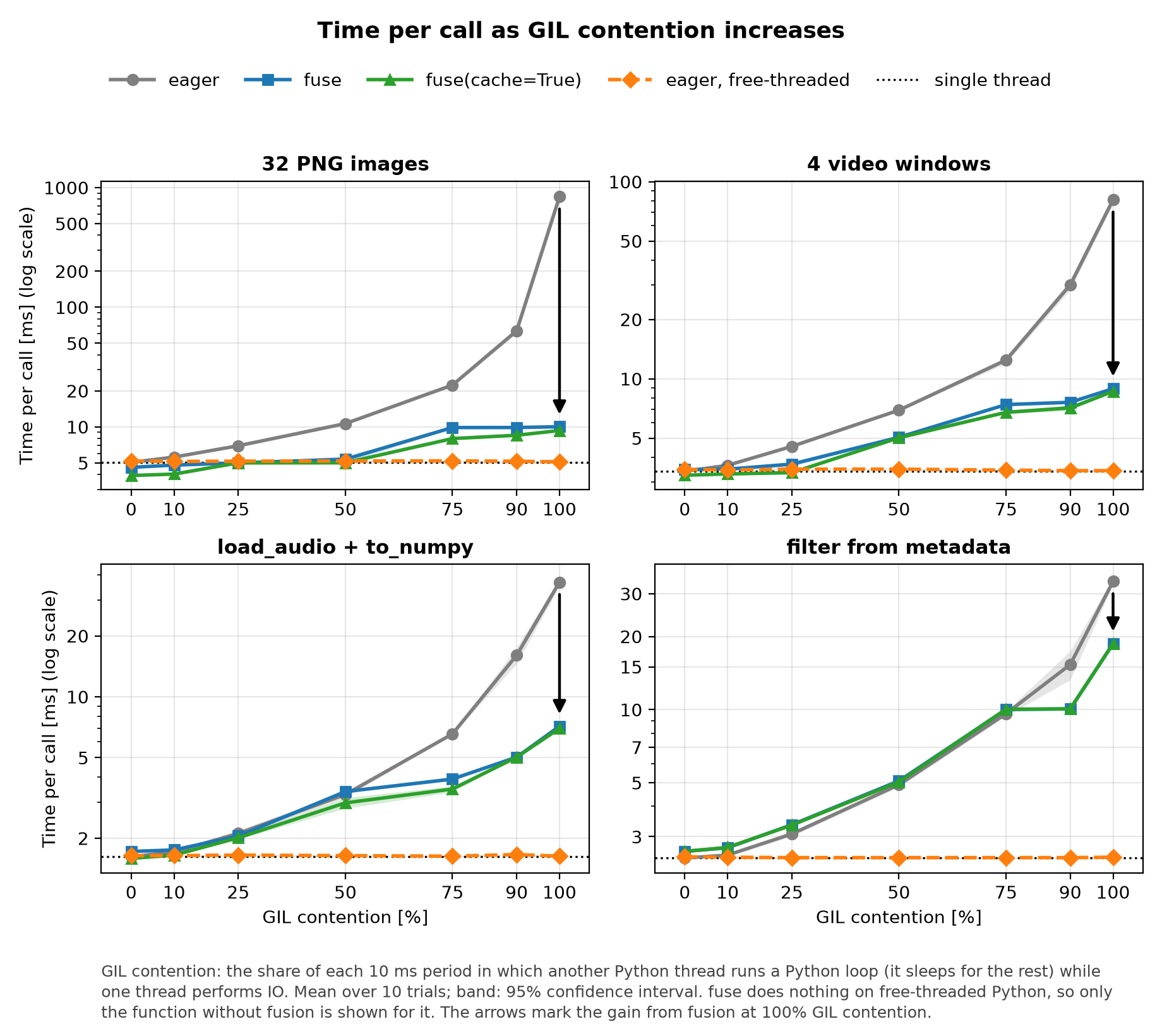
The following figure and table show the time per call of loading functions with
small test media as GIL contention grows from 0% to 100% (Python 3.14 and its
free-threaded build 3.14t, mean and 95% confidence interval of 10 trials, in
milliseconds). GIL contention is the share of time another Python thread runs
Python code: it runs a Python loop for that share of each 10 ms period and
sleeps for the rest, like a training loop that runs Python code between other
work. Without fusion, every native call has to re-acquire the GIL while the
other thread may hold it, so the time grows quickly with the contention. With
fusion, a call re-acquires the GIL about once, so its time grows much more
slowly. On the free-threaded build, which has no GIL, the time does not change.
The dotted line in the figure is the time without contention, and its y-axis is
in log scale. (The figure and the table also show fuse(cache=True),
explained below.)
Function |
Contention |
Eager |
|
|
3.14t eager |
|---|---|---|---|---|---|
32 PNG images |
0% |
5.05 ± 0.03 |
4.59 ± 0.02 |
3.92 ± 0.02 |
5.20 ± 0.06 |
32 PNG images |
10% |
5.59 ± 0.03 |
4.79 ± 0.12 |
4.03 ± 0.02 |
5.14 ± 0.02 |
32 PNG images |
25% |
6.95 ± 0.06 |
5.00 ± 0.04 |
5.00 ± 0.03 |
5.17 ± 0.06 |
32 PNG images |
50% |
10.65 ± 0.12 |
5.36 ± 0.33 |
5.01 ± 0.02 |
5.18 ± 0.06 |
32 PNG images |
75% |
22.34 ± 0.53 |
9.87 ± 0.16 |
7.98 ± 0.09 |
5.20 ± 0.05 |
32 PNG images |
90% |
63.56 ± 3.25 |
9.88 ± 0.13 |
8.51 ± 0.13 |
5.16 ± 0.06 |
32 PNG images |
100% |
839.74 ± 24.37 |
10.03 ± 0.04 |
9.32 ± 0.03 |
5.10 ± 0.02 |
4 video windows |
0% |
3.39 ± 0.01 |
3.46 ± 0.02 |
3.24 ± 0.02 |
3.46 ± 0.01 |
4 video windows |
10% |
3.64 ± 0.03 |
3.48 ± 0.02 |
3.29 ± 0.04 |
3.45 ± 0.01 |
4 video windows |
25% |
4.54 ± 0.07 |
3.69 ± 0.10 |
3.34 ± 0.02 |
3.48 ± 0.03 |
4 video windows |
50% |
6.93 ± 0.08 |
5.05 ± 0.03 |
5.02 ± 0.02 |
3.48 ± 0.04 |
4 video windows |
75% |
12.44 ± 0.46 |
7.40 ± 0.11 |
6.76 ± 0.12 |
3.44 ± 0.03 |
4 video windows |
90% |
29.96 ± 1.71 |
7.60 ± 0.10 |
7.12 ± 0.23 |
3.42 ± 0.03 |
4 video windows |
100% |
81.04 ± 4.39 |
8.91 ± 0.03 |
8.63 ± 0.05 |
3.42 ± 0.03 |
|
0% |
1.62 ± 0.01 |
1.72 ± 0.01 |
1.59 ± 0.01 |
1.64 ± 0.01 |
|
10% |
1.71 ± 0.03 |
1.75 ± 0.03 |
1.65 ± 0.01 |
1.64 ± 0.01 |
|
25% |
2.11 ± 0.08 |
2.05 ± 0.05 |
2.01 ± 0.03 |
1.65 ± 0.02 |
|
50% |
3.29 ± 0.11 |
3.40 ± 0.06 |
2.99 ± 0.18 |
1.64 ± 0.01 |
|
75% |
6.55 ± 0.05 |
3.92 ± 0.07 |
3.50 ± 0.12 |
1.63 ± 0.01 |
|
90% |
16.04 ± 1.49 |
5.03 ± 0.00 |
5.03 ± 0.00 |
1.66 ± 0.02 |
|
100% |
36.86 ± 1.63 |
7.15 ± 0.08 |
6.98 ± 0.06 |
1.63 ± 0.01 |
Metadata used |
0% |
2.45 ± 0.01 |
2.61 ± 0.01 |
2.61 ± 0.01 |
2.48 ± 0.02 |
Metadata used |
10% |
2.52 ± 0.03 |
2.70 ± 0.02 |
2.71 ± 0.02 |
2.47 ± 0.04 |
Metadata used |
25% |
3.08 ± 0.07 |
3.36 ± 0.05 |
3.35 ± 0.05 |
2.46 ± 0.03 |
Metadata used |
50% |
4.91 ± 0.10 |
5.09 ± 0.08 |
5.04 ± 0.02 |
2.46 ± 0.02 |
Metadata used |
75% |
9.62 ± 0.22 |
10.01 ± 0.04 |
10.04 ± 0.03 |
2.46 ± 0.02 |
Metadata used |
90% |
15.33 ± 2.09 |
10.07 ± 0.00 |
10.07 ± 0.00 |
2.46 ± 0.02 |
Metadata used |
100% |
33.72 ± 0.98 |
18.69 ± 0.09 |
18.67 ± 0.07 |
2.47 ± 0.04 |
When nothing else competes for the GIL, fusing makes no difference, or adds
a small overhead for recording the calls. The benefit comes only from
re-acquiring the GIL fewer times. With free-threaded Python, which does not
have the GIL, eager calls are not slowed down by other threads, so
fuse() does nothing there. (See
Free-threaded Python.)
Using fuse
Decorate the function that loads data with SPDL IO functions.
import spdl.io

filter_desc = spdl.io.get_video_filter_desc(scale_width=224, scale_height=224)

@spdl.io.fuse
def load_images(srcs: list[bytes]) -> spdl.io.CPUBuffer:
    frames = [
        spdl.io.decode_packets(spdl.io.demux_image(src), filter_desc=filter_desc)
        for src in srcs
    ]
    return spdl.io.convert_frames(frames)

buffer = load_images([data1, data2, data3])  # One call into the native code
The function runs as usual, but the SPDL IO functions do not execute immediately. They record operations and return placeholders for their results (packets, frames, buffers and their metadata). The recorded operations are executed in one native call when the function returns, and the placeholders in the returned value are replaced with the actual values.
Since the function itself runs as usual, Python code in it works as before, including loops, list comprehensions, random sampling and attributes of objects.
Using metadata in Python
Metadata, such as packets.width, frames.num_frames and
frames.get_pts(), is also recorded. It can be returned from the function
as-is.
When Python code needs an actual value, the operations recorded so far are
executed in one native call at that point. This happens, for example, when
branching on a value, computing a filter description from a value, or
operating on the array returned by to_torch().
@spdl.io.fuse
def load_video(src: bytes) -> tuple[torch.Tensor, list[int]]:
    packets = spdl.io.demux_video(src, timestamp=(0, 2))
    width, height = packets.width, packets.height
    # `width // 2` needs the actual value. The first native call demuxes,
    # and fetches both width and height.
    filter_desc = spdl.io.get_video_filter_desc(
        scale_width=width // 2, scale_height=height // 2,
    )
    frames = spdl.io.decode_packets(packets, filter_desc=filter_desc)
    pts = frames.get_pts()
    # `to_torch` needs the actual buffer. The second native call decodes,
    # fetches the PTS, and converts the frames.
    tensor = spdl.io.to_torch(spdl.io.convert_frames(frames))
    return tensor.permute(0, 3, 1, 2), pts
Pending metadata is fetched together, so reading multiple values in a row needs only one native call. To keep the number of native calls small, read metadata in Python only where it is necessary, and return the rest.
What is recorded
The following functions are recorded.
Demuxer(including demuxing multiple windows from one demuxer),demux_audio(),demux_video(),demux_image()andapply_bsf()convert_frames(),to_numpy(),to_torch(),to_numba()andto_jax()load_audio(),load_video(),load_image(),load_image_batch()andget_filter_desc()transfer_buffer(),decode_packets_nvdec(),nv12_to_rgb()andnv12_to_bgr(), when their input is recorded and the CUDA extension supports fusion.The metadata of demuxers, codecs, packets and frames,
clone(), and indexing video frames with an integer, a slice or a list of integers.
Operations that are not recorded run as usual with the actual values. These
include streaming demuxing and decoding, decode_image_nvjpeg(),
BSF, load_image_batch(strict=False), and attributes
that are not recorded. The recorded operations are executed before them.
CUDA operations
Passing device_config to the loading functions records the CPU-to-CUDA
transfer in the same native call as demuxing, decoding and conversion. The
cached program includes the transfer; device_config is a non-source
constant, keyed by object identity. The CUDA extension supplies native
operations without making CUDA a dependency of the CPU executor.
decode_packets_nvdec() records one-off NVDEC decoding,
including the automatic Annex B bitstream filter for H264/HEVC and RGB/BGR
conversion. Explicit apply_bsf() is supported as well.
Streaming NvDecDecoder operations are not recorded.
CUDA buffers can be returned directly or passed to to_torch().
Reading their attributes (e.g. shape or device_index) materializes them,
so these accesses prevent caching just like other unrecorded attributes.
Inputs that are already concrete, or extensions without the native factories,
use the eager path. Custom Python allocators, including the torch caching
allocator, acquire the GIL for their callbacks even during a fused native call.
Guidelines
- Errors run the function again
Recorded operations fail when they are executed, that is, when the function returns or when Python needs an actual value, not where the SPDL IO function is called. When that happens,
fuse()executes the function again without recording, so that the error is raised where the SPDL IO function is called, andtrystatements and logging in the function work as they do withoutfuse(). If recording fails instead, i.e. fusion rather than an operation fails (e.g. the function uses SPDL IO in a way thatfuse()does not support), the function is executed again without recording, and fusion is disabled for the function for the rest of the process. A warning with the cause is logged once. Python code in the function runs twice in both cases, so avoid side effects that must not be repeated, such as consuming an iterator or modifying an argument.- Do not decorate generators and coroutines
The recording ends when the decorated function returns, which, for generators and coroutines, happens before their body runs. Decorate a regular function that they call instead.
- Packets are consumed by decoding
As with eager calls,
decode_packets()andsample_decode_video()consume the packets. Using the packets after that raises an error. Usepackets.clone()to decode the same packets multiple times.- Returned values
The placeholders in the returned value are replaced with the actual values if they are in lists, tuples, named tuples and dicts, or in the fields of dataclass instances (in place, so the instance stays the same object). Placeholders in other objects (e.g. subclasses of
dict) are executed, and they behave like the actual values, but they are not instances of the actual classes. Return the results in such containers when the type matters. Returning the same value more than once returns the same object at each position.
Caching the recorded program
With cache=True, fuse() saves running the function in
Python as well.
Compared to the gain of fusing itself, the difference that cache=True makes
is marginal (see the figure and the table in Why fuse IO calls). At 100% GIL
contention, fusing saves 15 to 830 ms per call, while the cache saves a further
0.2 to 0.7 ms. Without contention, the cache saves 0.1 to 0.7 ms, the time to
run the function in Python. The last function uses metadata in Python, so it
cannot be cached, and cache=True makes no difference. Prefer the default
unless profiling shows otherwise.
@spdl.io.fuse(cache=True)
def load_images(srcs: list[bytes]) -> spdl.io.CPUBuffer:
    ...
After a call executes all the operations in one native call, the next call
with the same argument structure records the function as a program, with
the source arguments (str, bytes and other buffer objects) replaced
by placeholders. The subsequent calls with the same argument structure run
the program without executing the function. The argument structure is the
nesting of lists, tuples, named tuples and dicts (exact types, which are
passed with the same types when tracing), and the values of the arguments
that are not sources. The programs for the last 128 argument structures are kept.
This is correct only if the result of the function depends only on its
arguments. Do not use cache=True if the function uses random numbers,
or the state of objects or global variables.
Arguments are classified as sources by their type, so a str or a NumPy
array that is not a source is replaced by a placeholder as well. If the
function uses such an argument in any other way than passing it to SPDL IO
functions (e.g. formatting it into a string, comparing or indexing it), or
does not use it, fuse() detects it, and runs the function
without the cache for that argument structure.
Free-threaded Python
When the GIL is disabled, fuse() does nothing, and the function runs eagerly. Without the GIL, a native call does not wait for other threads when it returns, so recording only adds overhead.
The free-threaded series in Why fuse IO calls shows the time without the
GIL: it does not change with GIL contention. The following table compares
both builds in two other conditions (time per call in milliseconds, one
measurement each). “1 busy thread” is the time per call while another Python
thread runs a Python loop all the time, which is 100% GIL contention.
“8 loading threads” is the wall time per call while 8 threads call the
function concurrently, with no other Python thread, so it is the total time
divided by the number of calls of all 8 threads. The fused function was
measured before making fuse() do nothing without the GIL.
Function |
Condition |
3.14, Eager |
3.14, Fused |
3.14t, Eager |
3.14t, Fused |
|---|---|---|---|---|---|
32 PNG images |
1 busy thread |
796.69 |
13.91 |
3.47 |
3.59 |
|
1 busy thread |
36.07 |
11.78 |
1.31 |
1.40 |
32 PNG images |
8 loading threads |
1.22 |
0.51 |
0.46 |
0.56 |
The check is made on every call, because free-threaded Python enables the GIL when it imports an extension module that does not support running without the GIL.