The Cost of Inter-Process Communication
Whenever data crosses a process boundary — a stage dispatched to a
ProcessPoolExecutor, a pipeline run with
run_pipeline_in_subprocess(), or the workers of a
torch.utils.data.DataLoader — ordinary multiprocessing transport
can copy the payload from one process to another. Shared storage can instead
be passed by handle. Copying is not free, and for large payloads it is easy to
spend more time moving data between processes than doing useful work on it. This
page explains where that cost comes from, measures it, and describes ways to
avoid it.
SPDL does not remove this cost automatically — it is something to be aware of and
to design around.
An example: the PyTorch DataLoader
To make this concrete, let’s take a conventional
DataLoader built around a large in-memory dataset.
Constructing TorchVision’s ImageNet dataset object takes well under a second — it
scans the directory tree and builds a list of roughly 1.2 million
(path, label) entries. But wrapping it in a DataLoader with a few workers
stalls the first iteration for 20+ seconds before a single batch appears,
because, with spawn, the dataset object is serialized and copied into
every worker process. Building the list is cheap; shipping it across a
process boundary, once per worker, is not. fork inherits the initial
state instead, but can be unsafe after threads or accelerator state are
initialized. DataLoader launches its workers one at a time in either case. In production,
dataloaders built without care for this have taken more than 30 minutes to
initialize, as the per-worker copy compounds with dataset size and worker count.
The benchmark_ipc_dataloader example isolates the effect: a dataset of
byte strings (standing in for an ImageFolder’s paths) swept over total size
and worker count, timing the dataset build and the startup cost (iterator
creation through the first batch, when the workers are spawned and the dataset
shipped to each).
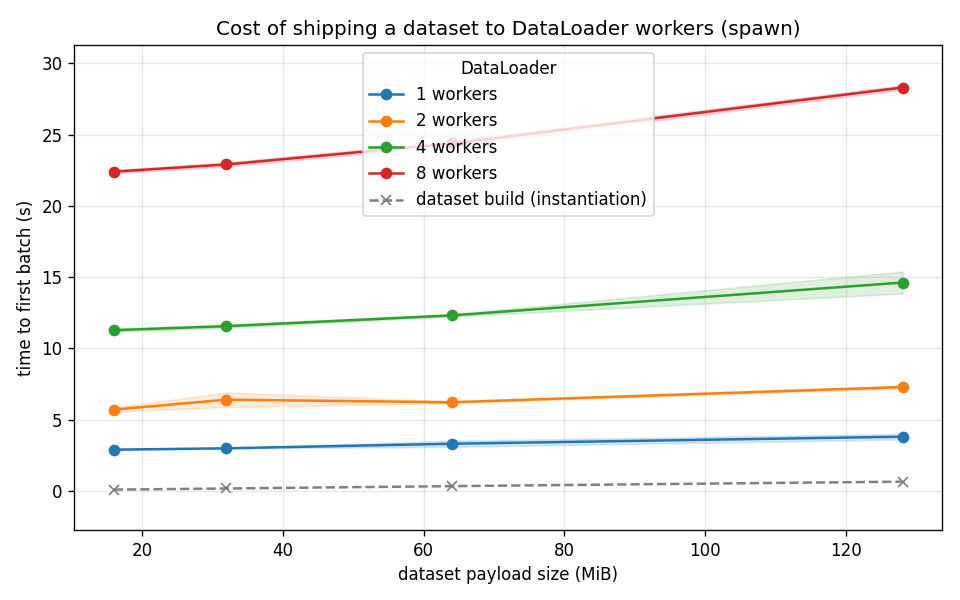
Building the dataset is cheap and roughly flat — no data crosses a boundary.
Startup cost grows with both payload size and worker count: each worker receives
its own serialized copy, so the transfer work scales with (payload size) ×
(worker count), reaching tens of seconds at the largest sizes and worker counts
even though __getitem__ here does essentially nothing.
Why copying between processes is expensive
Two separate costs are hiding in that transfer.
1. Serialization (pickling). Processes do not share memory, so an arbitrary
Python object cannot simply be handed to another process — it must be converted
to a flat byte stream (pickle) on the sending side and reconstructed on
the receiving side. Both halves cost CPU, and the reconstruction on the receiving
side — allocating the objects again in the worker — is often the more expensive
one. A structure of many small objects, such as a large list of (path, label)
entries, incurs this per object.
2. Transport (the copy itself). The resulting byte stream then has to travel from one address space to another. By default this goes through a pipe (or a socket-backed queue), and a pipe is a stream, not a shared region — so every byte is physically copied twice: once from the sender’s buffer into the kernel, and once from the kernel into the receiver’s buffer.
 producer process              kernel                 worker process
┌─────────────────┐          ┌──────────┐            ┌─────────────────┐
│ pickled dataset │  write() │   pipe   │   read()   │  rebuilt copy   │
│ (~100 MB blob)  │ ───────► │  buffer  │ ─────────► │  (~100 MB blob) │
└─────────────────┘  copy #1 └──────────┘   copy #2  └─────────────────┘
                    user→kernel            kernel→user

   the bytes never "move" — they are memcpy'd through the kernel, twice,
   and a whole second copy is rebuilt in the worker's address space
Chunking: a big payload through a small pipe
The transport has a second cost, hidden below the API in how the operating system actually moves the bytes. A pipe has bounded capacity — for example, 64 KiB for a Linux pipe with 16 pages of 4 KiB. Capacity varies by system and configuration. It cannot hold a hundred-megabyte payload, so the transfer cannot happen in one shot. Instead the payload is pushed through the pipe in increments: the writer can fill the buffer, then block until the reader has drained it, then fills it again. Producer and consumer ping-pong like this until the whole payload is through.
pickled buffer (e.g. 100 MB)              pipe capacity = 64 KiB (16 × 4 KiB)
┌────────────────────────────┐
│████████████████████████████│
└─────────────┬──────────────┘
              │ write() 64 KiB ───────────► [▓▓▓▓ pipe full ▓▓▓▓]
              │                                     │ read() drains 64 KiB ─► worker
              │ writer blocks until drained ◄───────┘
              │ write() next 64 KiB ──────► [▓▓▓▓ pipe full ▓▓▓▓]
              │                                     │ read() ─► worker
              ▼                                     ▼
   ... repeat ~1,600 times for 100 MB (100 MB ÷ 64 KiB) ...

   illustrative buffer-fill cycles; read/write sizes and wakeups depend
   on the reader, writer, and OS
So moving one large payload through a pipe can involve many copies, system calls, and waits, rather than one bulk transfer. The two costs compound: pickling produces a large buffer, and the reader and writer then have to move it through the pipe. With serialized startup, that work repeats for each worker.
Avoiding the cost
There are three broad ways to pay less:
Don’t cross the boundary at all. SPDL’s default is multi-threaded, not multi-process: threads share one address space, so passing data between stages is by reference — no pickling, no copy. When the heavy stages release the GIL, this can be the simplest and fastest option. See Pipeline Parallelism and Execution Models: MT, MTP, and MP.
Cross it fewer times. When a process boundary is unavoidable (a GIL-bound stage, or isolating the loader from the training process), keep whole regions of the pipeline together in the workers rather than paying a round trip per stage, and hand only finished batches back. This is what the MP and MTP patterns do; see Execution Models: MT, MTP, and MP and the “cost of crossing a process boundary” discussion in Pipeline Parallelism.
Make each crossing cheaper. For the payloads you do send across, prefer types that move through shared memory instead of the pickle/pipe path.
torch.Tensoralready does this: its multiprocessing reducer moves the tensor’s storage through shared memory and pickles a small handle, so a tensor can transfer more cheaply than its size suggests. Moving storage into shared memory the first time can still require a copy. Python’s nativebytesand NumPy arrays do not — they take the full pickle-and-copy path above — so a raw byte string is exactly the worst case, and the way to send one cheaply is to wrap it in a 1-Duint8tensor so it rides the tensor path. For the last bit of performance,SharedMemorySegmentPoolwrites supported binary payloads into a pre-mapped shared-memory region so the bulk bytes never enter the pipe at all — see the shared-memory arena case study.
See Memory and transport for current arena APIs and ownership. The common thread: ordinary transport costs scale with what you send across a process boundary. Keeping the boundary count low and the per-crossing payload light can keep IPC from becoming the bottleneck.