Get Started
The Aria Companion App allows you to set up and record using your Aria Gen 2 glasses via Bluetooth on an Android or iOS device. This guide covers:
- Downloading and installing the app
- Setting up your glasses
- Navigating the app
Companion App key features
- Fully wireless operation
- Check glasses status (temperature, GPS, battery, etc.)
- Handle and select between multiple paired Aria Gen 2 glasses
- Update glasses to the latest firmware
- Select and start recording profiles directly from the app
- Start recording, streaming over WebRTC, or both at once
- Data quality signals during recording and streaming
- Eye Tracking Calibration
- Manage security certificates for SDK/CLI access
Get the app
The current version of the Companion App is v285. Go to ARK Software Release Notes to learn more about the latest features.
- iOS
- Android
iOS
Requirements
If you're using iOS, your mobile device will need:
- OS version must be iOS 14 or above
- (Optional) TrueDepth camera (iPhone X or later) needed for Eye Tracking Calibration
Download and Install
The Aria Mobile Companion app is available on iOS as a beta app through TestFlight.
On your phone, scan this QR code:
to open the Aria Testflight invitation link and download the app.
Updating the app
- Open the TestFlight app
- Next to the Aria app, select Update
Android
Requirements
If you're using Android, your mobile device will need:
- Android OS version 10 or above installed
- ARM64 processor preferred
- (Optional) ARCore Depth API (https://developers.google.com/ar/devices) support needed for Eye Tracking Calibration
- 64-bit is preferred, although 32-bit is supported
Download and install
Follow one of these links on your Android device to download the app:
Mobile Companion App APK v285 - recommended (64-bit architecture) Mobile Companion App APK v285 - for 32-bit architecture
To update the app, download and install the latest version.
Installation troubleshooting
On Android, if you see an error message such as, “For security, your phone is not allowed to install unknown apps from this source,” you’ll need to enable your web browser to install unknown apps.
Aria Mobile Companion App install error message
- Go to Settings → Apps & notifications → Advanced → Special app access → Install unknown apps.
- Select the app (usually your internet browser) that you want to grant permission to install from unknown sources.
- Select Allow from this source
If you encounter problems ordering your device through the Companion App, please contact AriaOps@meta.com.
Log in
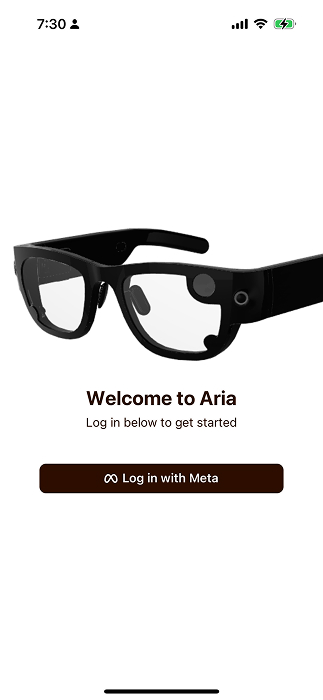
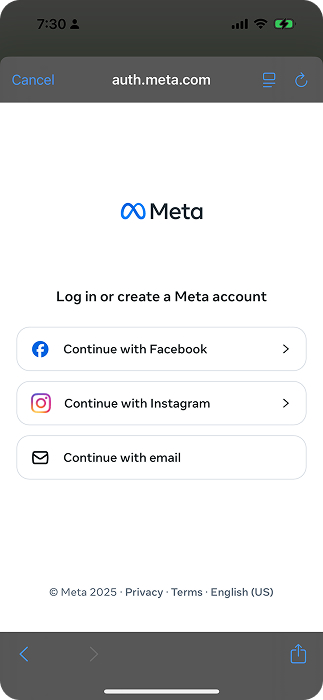
Open the Aria app and log in with your provided account. Tap Log in with Meta, then Continue with email. Review the Project Aria Research Community Guidelines and Health & Safety information.
Set up glasses
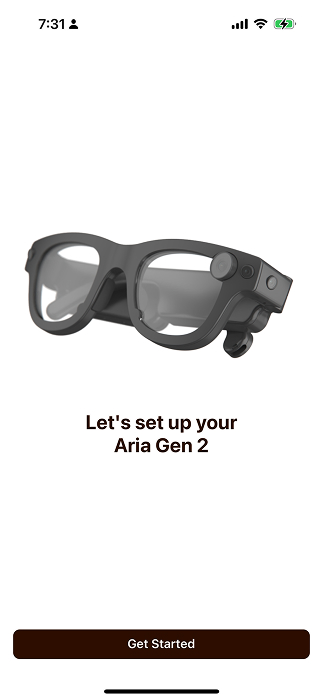
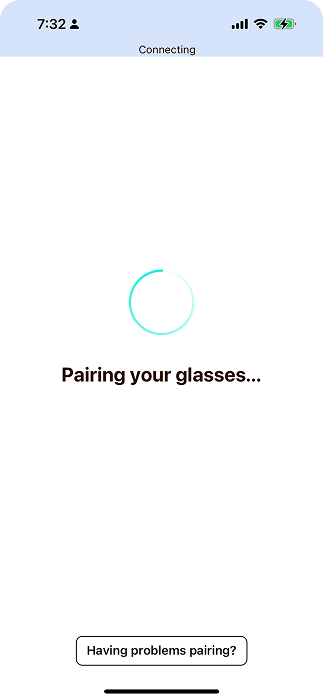
Follow the instructions in the app to pair your Aria Gen 2 glasses. You'll need to set up Wi-Fi in order to check for any software updates and complete the glasses setup.
Need help? Email AriaOps@meta.com.
Updating glasses
Automatic updates
OS updates occur automatically when glasses are plugged in and connected to Wi-Fi.
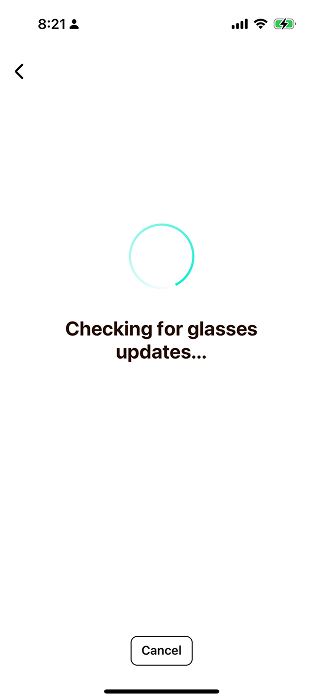
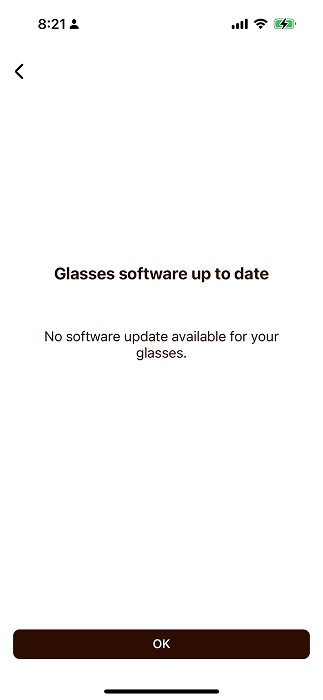
Manual updates
- From the dashboard tab (home icon), tap your glasses name at the top of the brown card.
- Scroll to Glasses OS.
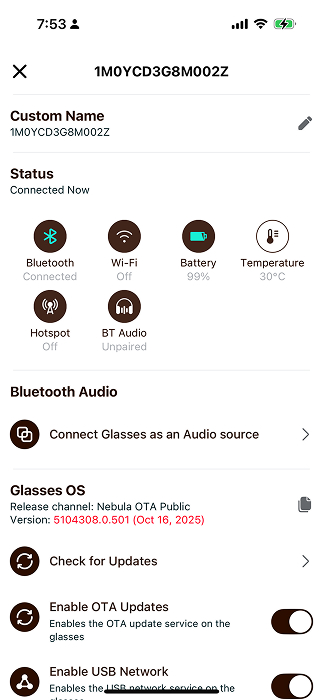
- Select Check for Updates.
- If an update is available, your glasses will reboot after updating.
App Dashboard
Once your glasses are set up, you'll be taken to the dashboard. The dashboard is the main tab of the companion app and shows the status of your glasses, including battery level, Wi-Fi, and audio pairing state.
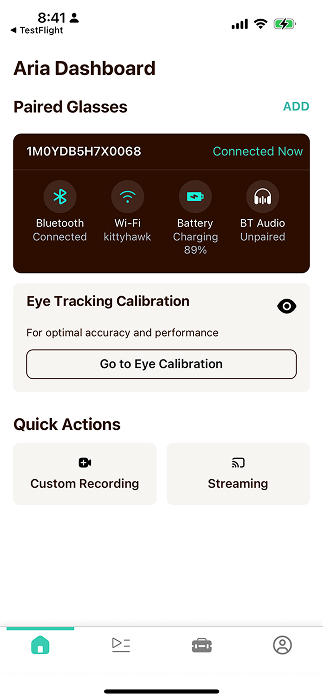
Eye Tracking Calibration
Aria Gen 2 estimates gaze on-device using a general model that works for any wearer. Eye Tracking Calibration measures how one specific person's eyes sit behind one specific pair of glasses, and produces a calibration recording that personalizes the gaze estimate for that pairing.
The calibration is worth running when gaze accuracy matters to your study — and it is what MPS Eye Gaze consumes to produce personalized results.
Eye Tracking Calibration is the name of the flow in the Companion App. The MPS documentation describes the same flow as the eye gaze calibration flow, and calls the file it produces an eye gaze calibration recording — because MPS consumes it for its Eye Gaze feature. They are the same thing.
Requirements
- Aria Gen 2 glasses, on the wearer's face, with the privacy switch slid forward
- Glasses running a current OS version. If an update is needed, the app prompts you to install it first and the calibration starts once the update finishes
- A phone with face tracking: a TrueDepth camera (iPhone X or later), or an Android device with ARCore Depth API support
- Even, moderate lighting. Avoid facing a window, a bright light, or a reflective surface, and remove any face coverings
Run a calibration
- From the dashboard tab, tap your glasses name at the top of the card to open the glasses details screen.
- Select Eye Tracking Calibration ("Personalize and calibrate eye tracking sensors").
- Work through the short tutorial, which explains the three things you need to do: keep your eyes fixed on the number, point your nose in the direction of the arrow while your eyes stay put, and freeze your head between steps while looking at the blinking dot. Tap Start Eye Calibration to begin, or Skip to go straight to the calibration steps without the tutorial.
- When prompted, put the glasses on and tap Got It. The glasses record for the duration of the calibration.
- Hold the phone vertically at arm's length — "just like you would when taking a selfie" — and tap Continue.
- Follow the on-screen target. Move your head slowly: you are being calibrated as you move.
On success the app confirms that you've "successfully calibrated your Aria device". If it reports Calibration Unsuccessful, see Companion App Troubleshooting.
A calibration describes one person wearing one specific device. If a different person wears those glasses, or the same person switches to another pair, run the calibration again for that combination.
Re-calibrating
The app asks you to re-calibrate when the glasses report that their calibration has gone stale — for example after an OS update — and at most once a week when you start a session with an eye-tracking profile. That prompt is titled Calibrate Your Eye Tracking; choose Calibrate Now to run it, or Not Now to continue with the session.
Using the calibration with MPS
Calibration writes a VRS recording to the glasses, tagged so that downstream tools recognize it as an eye gaze calibration. To use it:
- Download the calibration recording from the glasses with the Client SDK.
- Pass it to the MPS CLI with
--calibwhen requesting Eye Gaze:
aria_mps single -i ~/Downloads/Example/ --calib ~/Downloads/Example/calibration.vrs
Keep a local copy of the calibration VRS — you need the same file to reprocess those recordings later. See Providing an eye gaze calibration recording for the full workflow, including what the CLI reports when a file is not marked as a calibration.