Note
Go to the end to download the full example code.
Track 3 – Sleep onset (cross-user latency prediction)
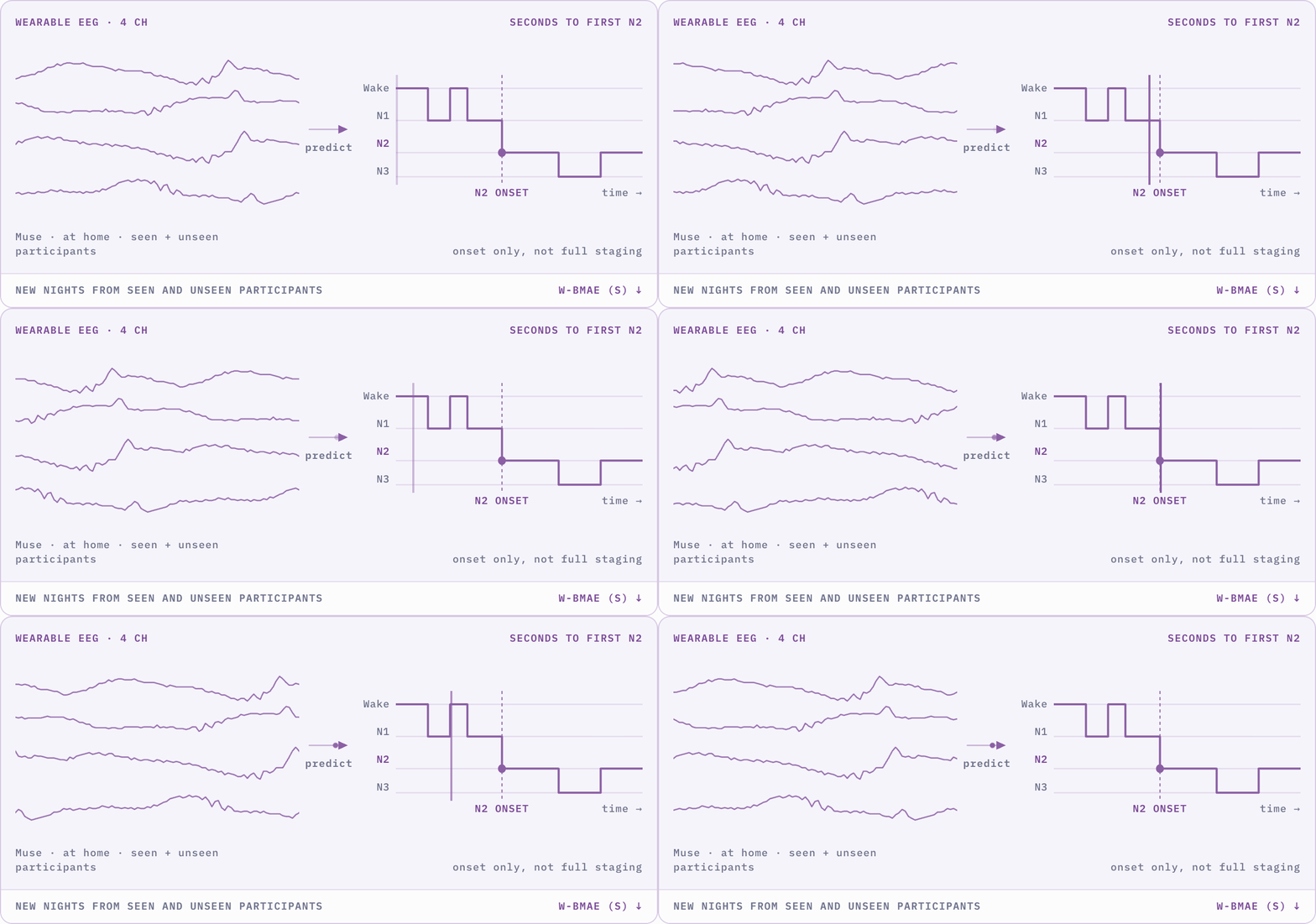
Given continuous four-channel wearable EEG recorded at home, predict the seconds remaining until the first N2 epoch – the first epoch scored N2, not the start of a run of consecutive N2 epochs. The competition tests generalisation across nights and across sleepers on one consumer device: training and evaluation use the same Muse headband, the same home protocol and the same target. Precise onset timing replaces full hypnogram reconstruction because a sparse wearable montage supports it poorly.
Shift: nights and sleepers, on one consumer device. The evaluation cohort contains both sleepers seen in training and sleepers never seen in training, so a model has to hold up on new nights from familiar people as well as on new people. Night-to-night variation, motion artifacts, impedance changes and channel dropout come with the home setting.
Headline metric: binned onset error in seconds, lower is better, but the binning is weighted differently in each phase. Both phases split the error by true time to onset into [0, 40), [40, 90), [90, 300) and [300, 600] s.
Sealed Muse phase: W-bMAE. The four ranges carry severity weights of 10x, 5x, 3x and 1x, so an error close to onset costs far more than one ten minutes out. W-bMAE is then computed separately over seen subjects (new nights from people in the training set) and unseen subjects, and the ranking score is the macro-average of those two, weighting night-to-night and inter-person generalisation equally.
Warm-up phase: W-bMAE on the public Muse data, computed for each recording over its non-empty ranges, then averaged over recordings, with no seen/unseen split.
_sleep_onset_streamlogs the warm-up score astest/wbmae_stream_mean(neuralbench.metrics.BinnedMAEwithbin_weights, per recording);test/bmaeis the unweighted bMAE over all windows. Nothing in the start kit computes the seen/unseen macro-average.Data: continuous Muse wearable EEG sampled at 128 Hz, with
n2_onsetannotations on the training cohort and a separate hidden evaluation cohort recorded with the same hardware and protocol. The public release contains 540 recordings from 203 participants, totaling about 157.52 hours. Its supplied split is 500 training recordings and 40 test recordings, all from participants seen in training. These counts do not describe the sealed cohort. The onset thatAddSleepOnsetTargetsextracts is the earliest annotated N2 event of the recording, which is exactly the competition’s definition.
Note
Muse data are available as NEMAR nm000287, version 1.0.0, by Muse Team under
CC-BY-NC-SA-4.0. They are the default dataset of neuralbench eeg
_sleep_onset_stream, which uses the supplied session split and selects
checkpoints on the per-recording W-bMAE; it does not reproduce the sealed
score.
The release’s session tables place every N2 onset exactly 300 s before
the recording end, so total recording length is not a legitimate
predictive input. _sleep_onset_stream feeds the
signal at its native rate, unfiltered and unscaled apart from the
conversion to microvolts, so no whole-recording statistic reaches the
model; a model config that sets its own preprocessing, such as
reve’s, overrides this. To preprocess each window, see
Preprocessing inside the model.
New to NeuralBench? Start here
This page is a track guide, not an introduction to the ecosystem. If you arrived straight from the competition website:
Challenge overview – what NeuralBench is, how it relates to the competition, and the baseline numbers for all four tracks.
Installation and the quickstart – get a task running on a 1.5 GB dataset before you download anything large.
Official Track 3 guide – registration, rules, data access, prizes, leaderboard. Authoritative on every competition matter; this page only covers the code.
Where to find this task in NeuralBench
NeuralBench has two versions of this task. Use ``_sleep_onset_stream`` for the competition, in both phases.
_sleep_onset_streamscores each recording one 5 s window at a time, forward in time from the start of the recording, as Codabench does, and itstest/wbmae_stream_meanis the warm-up leaderboard’s measurement. A model’s optionalreset_state()is called on a fresh copy of the model at the start of each recording (data.stream_by: [timeline], see Modifying the training loop). Validation stays batched; setdata.val_batch_size: 1to select checkpoints on streams too, at several times the training cost. The leading underscore only keeps the task out ofneuralbench eeg all.Sleep onset prediction is the NeuralBench benchmark version: validation and test cover the last 20 minutes before N2 onset of every recording, each window scored independently. The baseline numbers in the challenge overview come from it, on its own default dataset,
Kemp2000Analysis(Sleep-EDF Expanded, 78 participants recorded over up to two nights each, 2 EEG channels, full polysomnography). Its scores are not comparable with_sleep_onset_stream’s, as the test windows differ.
Both versions share the split, target and loss. _sleep_onset_stream
also feeds the signal unprocessed (see the note above), adds the
per-recording W-bMAE, defaults to the Muse data, and selects Sleep-EDF with
--dataset kemp2000analysis:
CLI:
neuralbench eeg _sleep_onset_streamDefault dataset:
Interaxon2026Muse(NEMAR nm000287, ~1.1 GB: 540 at-home recordings from 203 participants, 4 EEG channels – TP9, AF7, AF8, TP10 – at 128 Hz, first-N2 annotations only).Target: the time remaining until the first N2 epoch, which
AddSleepOnsetTargets+SleepOnsetTargetExtractorrecompute for every window asclip(n2_onset - window_stop, 0, 600)seconds. The task therefore predicts once per 5-second window rather than once per recording, and the competition’s singletau_hatiswindow_stop + predictionread off any window within 600 s of onset, where the cap has not saturated the target.Headline metric key:
test/wbmae_stream_mean(W-bMAE in seconds, per recording, averaged over recordings).
What the config is. A NeuralBench task is one config.yaml, and
nothing else: a YAML overlay on the neuralbench/defaults/ configs naming
the study to load, how to split it, what the target is, the loss, and the
metrics. Reading it is the fastest way to know exactly what the baseline
does.
Show tasks/eeg/_sleep_onset_stream/config.yaml
# Copyright (c) Meta Platforms, Inc. and affiliates.
# All rights reserved.
#
# This source code is licensed under the license found in the
# LICENSE file in the root directory of this source tree.

# sleep_onset on interaxon2026muse, tested as streams; diff guarded by test_stream_task_diff
# Warm-up benchmark on the supplied session split, not the sealed protocol.

data:
  neuro:
    frequency: native
    filter: null
    notch_filter: null
    scaler: null
    clamp: null
    scale_factor: 1.0e+6  # V -> uV
  study:
    source:
      name: Interaxon2026Muse
    split:  # supplied session split; validation subjects have no test session
      name: Chain
      steps:
        valid_group:
          name: CreateColumn
          column: valid_group
          query_row: "~subject.isin(subject.where(split == 'test'))"
          query_column_name: subject
        split:
          name: PredefinedSplit
          test_split_query: null
          col_name: split
          valid_split_by: valid_group
          valid_split_ratio: 0.2
          valid_random_state: 33
        keep_test_sleepers_in_train:
          name: CreateColumn
          column: split
          query_row: split.isna()
          query_value: train
          on_column_exists: ignore
    annotate_sleep_onset:  # no crop or random start: Muse is curated to <= 30 min pre-N2
      name: AddSleepOnsetTargets
  # Sleep-EDF (Kemp2000) recordings only expose bipolar derivations (Fpz-Cz,
  # Pz-Oz) whose MNE ch_locs are NaN, so the default ``ch_locs``-derived
  # position mapping in ``ChannelPositions`` produces all-``INVALID_VALUE``
  # positions.  Explicitly use the standard_1020 montage so the split-on-``-``
  # fallback resolves Fpz-Cz -> Fpz and Pz-Oz -> Pz to real 3D coordinates.
  channel_positions:
    layout_or_montage_name: standard_1020
  target:
    =replace=: true
    name: SleepOnsetTargetExtractor
    event_types: SleepOnsetMarker
    aggregation: trigger
    cap_s: 600.0
  trigger_event_type: SleepOnsetMarker
  start: 0.0
  duration: 5.0
  stride: 5.0
  sampler:
    name: RegressionBinSampler
    bin_edges: [0.0, 40.0, 90.0, 300.0, 600.0]
  summary_columns: [n2_onset]
  test_batch_size: 1
  stream_by: [timeline]
brain_model_output_size: &brain_model_output_size 1
trainer_config:
  monitor: val/wbmae_stream_mean
  mode: min
  patience: 7
  n_epochs: 40
loss:
  name: MultiLoss
  losses:
    mse:
      name: MSELoss
  weights:
    mse: 0.0001  # targets are in [0, 600] s; weight=0.0001 (0.01^2) keeps MSE <= ~36 so gradient clipping does not saturate.
metrics: !!python/object/apply:operator.add
  - !!python/object/apply:neuralbench.metric_configs.get_sleep_onset_metric_configs []
  - - log_name: wbmae_stream_mean  # W-bMAE per recording, averaged over recordings
      name: GroupedMetric
      metric_name: BinnedMAE
      kwargs:
        bin_boundaries: [0.0, 40.0, 90.0, 300.0, 600.0]
        bin_weights: [10.0, 5.0, 3.0, 1.0]
      reduction: mean
Split and model selection
Split. The supplied session split, read by PredefinedSplit from the
release’s split column: 500 training and 40 test recordings, all test
sleepers seen in training. Twenty percent of the subjects without a test
recording (seed 33) are held out for validation, so every test sleeper
keeps its training recordings: 170 train / 33 validation subjects
(412 / 88 recordings). The PSG variants instead split
participant-level 60 / 20 / 20 by SklearnSplit – on Sleep-EDF’s 78
participants that is 46 train / 16 validation / 16 test.
Those 40 Muse test recordings are the Codabench warm-up evaluation set.
A _sleep_onset_stream test/wbmae_stream_mean and a warm-up
leaderboard score are therefore the same measurement.
The sealed phase is a different story. Its Muse cohort mixes seen and unseen sleepers, while the warm-up test holds no unseen sleeper, so the sealed score is not something the starter kit can approximate.
Model selection. The checkpoint with the lowest ``val/wbmae_stream_mean`` is kept – the warm-up score, just on the validation fold. Training runs for at most 40 epochs and stops early after 7 epochs without improvement; only that single best checkpoint is scored on test.
How to change it, in increasing order of effort:
--dataset <name>mergestasks/eeg/_sleep_onset_stream/datasets/<name>.yamlover the base config. That is how Sleep-EDF and the other PSG corpora below are selected.-m <model>and-w <preset>swap the architecture and the adaptation strategy (frozen probe, LoRA, full fine-tuning) without touching any file.Anything else – the 600 s cap, the 5 s window, the learning rate – is a config edit. From Python, pass dotted keys to
evaluate_model()(overrides={"data.duration": 30.0}). From a source checkout (pip install -e), editconfig.yamldirectly, or add your owndatasets/*.yamlvariant beside the existing ones and select it with--dataset. Both routes are described in Adding a New Task.
Reproducing the baseline
This is the cheapest of the four tracks to get running end to end, which makes it a good first target whichever track you plan to submit to.
# 1. Download the Muse data into DATA_DIR: ~1.1 GB. One-off per
#    machine, and safe to interrupt and re-run.
neuralbench eeg _sleep_onset_stream --download

# 2. Prepare CACHE_DIR -- read the 540 recordings and cut them into 5 s
#    windows once, so every later run reads the cache instead. No GPU
#    needed, and it fans out over SLURM when one is configured.
neuralbench eeg _sleep_onset_stream --prepare

# 3. Sanity check before you queue anything: 2 epochs, a data subset, one
#    seed, always in-process, so progress lands in your terminal. Name
#    the model you actually plan to run -- a bare --debug takes the
#    config default, which is EEGNet.
neuralbench eeg _sleep_onset_stream -m eegnet --debug

# 4. Same check for the foundation model. The first build pulls REVE's
#    weights from the HuggingFace Hub, which needs network access; doing
#    it here rather than in a queued run keeps any failure in your
#    terminal instead of a job log.
neuralbench eeg _sleep_onset_stream -m reve --debug

# 5. Full baseline -- task-specific model (EEGNet). The default grid is
#    three seeds (concurrent on SLURM).
neuralbench eeg _sleep_onset_stream -m eegnet

# 6. Full baseline -- foundation model (REVE), fine-tuned end to end.
#    ~69M parameters against EEGNet's ~1.5k, all of them trainable here,
#    so this one wants a datacentre GPU rather than a laptop; it also
#    applies its own preprocessing (200 Hz, filtered, scaled) instead of
#    the task's raw signal, warming a second cache. Its scaler is fit on
#    each whole recording, which a streamed submission cannot do, so its
#    test score is optimistic.
neuralbench eeg _sleep_onset_stream -m reve
Pretrained model weights covers the hub cache, and no run has a CPU
fallback – --debug included.
Steps 5 and 6 cache the test-metric dictionary under SAVE_DIR –
test/wbmae_stream_mean is the headline number – and re-running the
same command with --plot-cached turns those cached metrics into comparison plots and CSV
tables without retraining. On SLURM they return as soon as the grid is
queued, so the numbers appear in the job logs rather than your terminal; see
Collecting and plotting your results.
Evaluating a model of your own
A model that lives in your own codebase needs no YAML here:
evaluate_model() takes the built instance, wraps it in a
probe sized to the task, and returns the scores as a DataFrame.
from neuralbench import check_model, evaluate_model

print(check_model(my_model, "eeg", "_sleep_onset_stream"))  # shapes only, seconds
scores = evaluate_model(my_model, "eeg", "_sleep_onset_stream", name="my-fm", debug=True)
See Evaluating your own model for what
forward has to accept, the adaptation presets, and how to fan the runs
out to SLURM.
Where the competition data diverges
The competition’s own shift is cross-user on a single device. The default
Muse data come from that device, home protocol and target, so on them only
the split (no unseen sleeper in the test, see Split and model selection) and
the seen/unseen macro-average differ from what you will be scored on. Prior
filters, exact hardware generation and N2 scoring methodology are
undocumented. An existing copy can be placed directly at
DATA_DIR/Interaxon2026Muse; downloaded copies live under
Interaxon2026Muse/download/nm000287. Cite Muse Team, Muse Sleep-Onset
EEG, version 1.0.0, DOI 10.82901/nemar.nm000287, and retain the
CC-BY-NC-SA-4.0 attribution.
The three PSG corpora registered for this task are exactly the three public
datasets the competition lists for Track 3, and all use the same
AddSleepOnsetTargets pipeline and metrics as the default. Their
recordings run for hours before N2, so they keep only the last 20 minutes
before onset, and validation and test streams start at a random time within
them, so the time since a stream began says little about the target:
# Sleep-EDF Expanded: ~7 GB raw (about 4 min
# to download on a fast link) + ~18 GB cache (~15 min to prepare over
# 20 SLURM jobs), then ~6 min per EEGNet seed and ~8 min per REVE seed
neuralbench eeg _sleep_onset_stream --dataset kemp2000analysis

# PhysioNet/CinC Challenge 2018: 994 labelled subjects, by far the most
# sleepers, providing a larger cross-user proxy than the public Muse set.
# Also by far the largest: ~285 GB raw
# plus ~40 GB of cache.
neuralbench eeg _sleep_onset_stream --dataset ghassemi2018you

# HMC Sleep Staging: 151 clinical whole-night recordings, ~17 GB raw
neuralbench eeg _sleep_onset_stream --dataset alvarez2022haaglanden
They add a second, artificial shift on top, because the only public sleep-onset data with scored hypnograms is clinical polysomnography. On them, three more axes differ from what you will be scored on:
Hardware: research-grade PSG vs the consumer-grade Muse headband (4-channel frontotemporal EEG, no EOG). Expect to drop or re-map channels in the dataloader, and treat any number you get there as an upper bound on signal quality.
Cohort and recording context: laboratory monitored sleep vs home recordings with movement artifacts, impedance changes and channel dropout.
Annotations: full hypnograms vs
n2_onsetevents only on the training set. NeuralBench already trains onSleepOnsetMarkerevents, so the model interface does not change.
Submission outputs (per the competition):
a direct onset estimate
tau_hatin seconds, orper-window time-to-onset predictions, or
per-window sleep probabilities.
The current NeuralBench head produces the second format directly, and the first by the conversion above.
Total running time of the script: (0 minutes 0.000 seconds)