Note
Go to the end to download the full example code.
Track 2 – BCI decoding (cross-session)
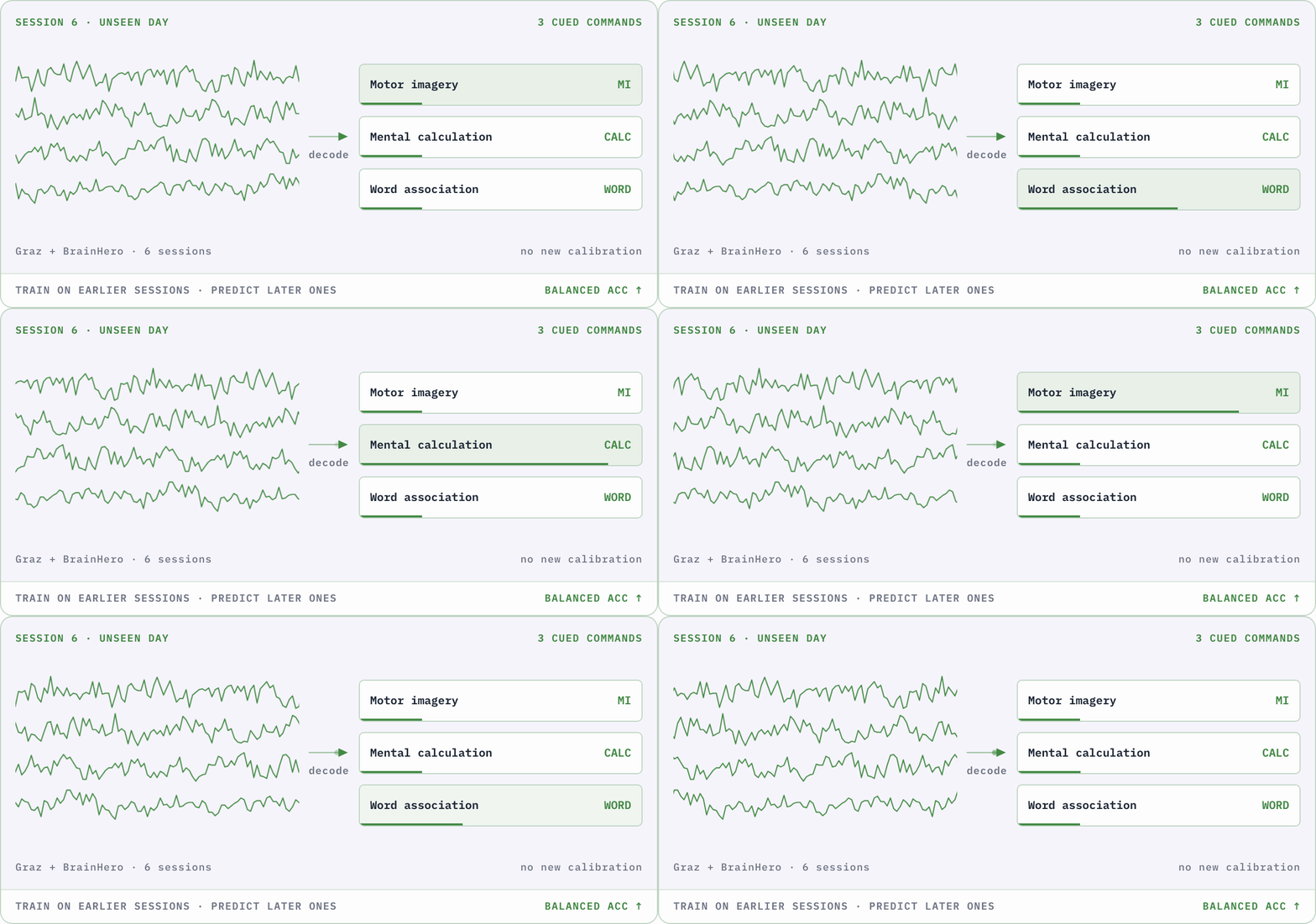
Given short EEG windows recorded while a user performs one of three cued mental commands (kinesthetic motor imagery, mental calculation, or word association), decode the active command. The competition tests cross-session generalisation: models train on a user’s earlier sessions and are scored on their later ones, with no per-session recalibration allowed.
Shift: earlier sessions -> later sessions (Graz + BrainHero contexts), within the same user.
Headline metric: balanced accuracy computed for each session of each subject, then averaged over sessions (higher is better).
Data: 20 subjects, 6 sessions each, 47 channels (43 EEG, 2 EMG, 2 EOG) at 500 Hz, ~80 hours in total. Sessions 1-3 of the 10 evaluation subjects are released as labelled calibration; sessions 4-6 are the hidden test set. The 10 training subjects have all 6 sessions released.
Note
The training release of the official Track 2 corpus is available as
NEMAR nm000290, version 1.0.0:
112 runs from 14 sessions of 10 participants, 41 EEG channels at
500 Hz (CC-BY-4.0). It is the default dataset of neuralbench eeg
_motor_imagery_stream, which runs a local subject-disjoint benchmark
on it, not the official split or the sealed evaluation.
Starter-kit analogs below lists the other NeuralBench tasks that
come closest, one per axis of the official task.
New to NeuralBench? Start here
This page is a track guide, not an introduction to the ecosystem. If you arrived straight from the competition website:
Challenge overview – what NeuralBench is, how it relates to the competition, and the baseline numbers for all four tracks.
Installation and the quickstart – get a task running on a 1.5 GB dataset before you download anything large.
Official Track 2 guide – registration, rules, data access, prizes, leaderboard. Authoritative on every competition matter; this page only covers the code.
Where to find this task in NeuralBench
NeuralBench has two versions of this task. Use ``_motor_imagery_stream`` for the competition.
_motor_imagery_streamscores each session one window at a time, forward in time: test windows come one per batch, its runs in recording order, and a model’s optionalreset_state()is called on a fresh copy of the model at the start of each session (data.stream_by: [subject, session], see Modifying the training loop). A stateful model can therefore adapt to a session as it goes, across its runs, but carries nothing over to the next one. Validation stays batched; setdata.val_batch_size: 1to select checkpoints on streams too, at several times the training cost. The leading underscore only keeps the task out ofneuralbench eeg all.Motor imagery classification is the NeuralBench benchmark version, which scores windows independently, in batches. The baseline numbers in the challenge overview come from it, on its own default dataset,
Stieger2021Continuous(62 subjects of 4-class MI). With--dataset dreyer2026proteusit tests on the same windows as_motor_imagery_stream, but with its own preprocessing.
Both versions share the split, target and loss. _motor_imagery_stream
also feeds the signal in microvolts, without the default per-recording
scaler or clamping (resampling and filters stay; to scale each window, see
Preprocessing inside the model), adds the per-session
balanced accuracy, defaults to the competition corpus, and ships
only the two other dataset variants these pages use, dreyer2023 and
tangermann2012; the other MI corpora are variants of motor_imagery.
CLI:
neuralbench eeg _motor_imagery_streamDataset:
Dreyer2026Proteus(NEMAR nm000290, ~1.5 GB), the training release of the official corpus: 10 participants, 41-channel EEG, the three cued commands – motor imagery, mental subtraction, word generation – with the Graz and BrainHero interfaces. Each window covers 1-5 s after a cue. Every run mixes the three commands in random order.Shift: held-out subjects, not the cross-session shift of the competition. Use it to validate the training pipeline and architecture choice.
Headline metric key:
test/bal_acc_stream_mean(balanced accuracy per subject and session, averaged over sessions).
--dataset dreyer2023 selects Dreyer2023Large (87 subjects,
27-channel EEG, 2-class motor imagery – left hand / right hand, ~19 GB),
the corpus Codabench scores Track 2 against during the warm-up phase.
What the config is. A NeuralBench task is one config.yaml, and
nothing else: a YAML overlay on the neuralbench/defaults/ configs naming
the study to load, how to split it, what the target is, the loss, and the
metrics. Reading it is the fastest way to know exactly what the baseline
does.
Show tasks/eeg/_motor_imagery_stream/config.yaml
# Copyright (c) Meta Platforms, Inc. and affiliates.
# All rights reserved.
#
# This source code is licensed under the license found in the
# LICENSE file in the root directory of this source tree.

# motor_imagery on dreyer2026proteus, tested as streams; diff guarded by test_stream_task_diff
# Local subject-disjoint benchmark on the training release, not the official
# split or the sealed protocol.

data:
  neuro:
    frequency: 120.0
    filter: [0.1, 75.0]
    notch_filter: [50.0, 60.0]
    scaler: null
    clamp: null
    scale_factor: 1.0e+6  # V -> uV
  study:
    source:
      name: Dreyer2026Proteus
    split:
      name: SklearnSplit
      split_by: subject
      valid_split_ratio: 0.2
      test_split_ratio: 0.2
      valid_random_state: 33
      test_random_state: 33
  target:
    =replace=: true
    name: LabelEncoder
    event_types: Stimulus
    event_field: code
    return_one_hot: true
    aggregation: trigger
  trigger_event_type: Stimulus
  start: 1.0  # cue at 0 s, feedback from 3 s, trial end at 8 s
  duration: 4.0
  summary_columns: [code]
  test_batch_size: 1
  stream_by: [subject, session]
compute_class_weights: true
brain_model_output_size: &brain_model_output_size 3
trainer_config.monitor: val/bal_acc_stream_mean
trainer_config.mode: max
loss:
  name: CrossEntropyLoss
  kwargs:
    label_smoothing: 0.1
metrics: !!python/object/apply:operator.add
  - !!python/object/apply:neuralbench.metric_configs.get_classification_metric_configs
    - *brain_model_output_size
  - - log_name: bal_acc_stream_mean  # balanced accuracy per stream, averaged over streams
      name: GroupedMetric
      metric_name: Accuracy
      kwargs: {task: multiclass, num_classes: *brain_model_output_size, average: macro}
      reduction: mean
Show tasks/eeg/_motor_imagery_stream/datasets/dreyer2023.yaml
# Copyright (c) Meta Platforms, Inc. and affiliates.
# All rights reserved.
#
# This source code is licensed under the license found in the
# LICENSE file in the root directory of this source tree.

# Dreyer2023Large combines parts A (subjects 1-60), B (61-81), and C (82-87).
# 6 subjects in part C are re-recordings of subjects from A or B under
# different IDs (exact mapping unknown). We assign part B (61-81) to test
# so that train/test populations are disjoint. Part C subjects stay in
# train only, where overlap with A is harmless.

data:
  # no electrode locations recorded (NaN ch_locs)
  channel_positions.layout_or_montage_name: standard_1005
  study:
    source:
      name: Dreyer2023Large
    split:
      =replace=: true
      name: PredefinedSplit
      test_split_query: "subject.isin(['Dreyer2023Large/61', 'Dreyer2023Large/62', 'Dreyer2023Large/63', 'Dreyer2023Large/64', 'Dreyer2023Large/65', 'Dreyer2023Large/66', 'Dreyer2023Large/67', 'Dreyer2023Large/68', 'Dreyer2023Large/69', 'Dreyer2023Large/70', 'Dreyer2023Large/71', 'Dreyer2023Large/72', 'Dreyer2023Large/73', 'Dreyer2023Large/74', 'Dreyer2023Large/75', 'Dreyer2023Large/76', 'Dreyer2023Large/77', 'Dreyer2023Large/78', 'Dreyer2023Large/79', 'Dreyer2023Large/80', 'Dreyer2023Large/81'])"
      col_name: split
      valid_split_by: subject
      valid_split_ratio: 0.2
      valid_random_state: 33
  start: 0.0
brain_model_output_size: &brain_model_output_size 2
metrics: !!python/object/apply:operator.add
  - !!python/object/apply:neuralbench.metric_configs.get_classification_metric_configs
    - *brain_model_output_size
  - - log_name: bal_acc_stream_mean
      name: GroupedMetric
      metric_name: Accuracy
      kwargs: {task: multiclass, num_classes: *brain_model_output_size, average: macro}
      reduction: mean
How to change it, in increasing order of effort:
--dataset <name>mergestasks/eeg/_motor_imagery_stream/datasets/<name>.yamlover the base config.-m <model>and-w <preset>swap the architecture and the adaptation strategy (frozen probe, LoRA, full fine-tuning) without touching any file.Anything else – window length, learning rate, split – is a config edit. From Python, pass dotted keys to
evaluate_model()(overrides={"data.duration": 3.0}). From a source checkout (pip install -e), editconfig.yamldirectly, or add your owndatasets/*.yamlvariant beside the existing ones and select it with--dataset. Both routes are described in Adding a New Task. The split is the field to reach for here: see Adapting to the competition setup.
Split and model selection
Split (task default ``Dreyer2026Proteus``). Subject-level
60 / 20 / 20 drawn by SklearnSplit with split_by: subject and both
seeds fixed at 33, which on 10 participants resolves to 6 train /
2 validation / 2 test (1,521 / 379 / 755 windows). Every session of a
participant lands in the same fold.
Split (``–dataset dreyer2023``). Subject-level and predefined, not
random. Dreyer2023Large pools the study’s parts A (subjects 1-60),
B (61-81) and C (82-87); PredefinedSplit assigns all 21 subjects of
part B to test and everything else to train, then holds out 20 % of the
remaining subjects as validation (valid_split_by: subject, seed 33).
Part B is used for test because six part-C subjects are re-recordings of
part-A subjects under different IDs, so carving test out of A or C could
leak a person across folds. Every subject therefore appears in exactly one
fold, and the partition is identical on every machine.
That part-B test partition is the current Codabench warm-up evaluation
set, so a test/bal_acc_stream_mean from this configuration and a
warm-up leaderboard score are computed on the same windows.
Either way the starter-kit shift is cross-subject, while the sealed phase’s is cross-session within subject. See Adapting to the competition setup for what changes.
Model selection. The checkpoint with the highest ``val/bal_acc_stream_mean`` is kept – the headline metric, just on the validation fold. Training runs for at most 40 epochs and stops early after 5 epochs without improvement; only that single best checkpoint is scored on test.
Averaging over sessions makes every session count equally regardless of
how many windows it holds. test/bal_acc, also logged, pools all
windows instead – a different number from the same predictions.
Reproducing the baseline
# 1. Download Dreyer2026Proteus into DATA_DIR: ~1.5 GB. One-off per
#    machine, and safe to interrupt and re-run.
neuralbench eeg _motor_imagery_stream --download

# 2. Preprocess into CACHE_DIR -- resample, filter and window
#    every recording once, so each later run reads the cache instead.
#    No GPU needed, and it fans out over SLURM when one is configured.
neuralbench eeg _motor_imagery_stream --prepare

# 3. Sanity check before you queue anything: 2 epochs, a data subset, one
#    seed, always in-process, so progress lands in your terminal. Name
#    the model you actually plan to run -- a bare --debug takes the
#    config default, which is EEGNet.
neuralbench eeg _motor_imagery_stream -m eegnet --debug

# 4. Same check for the foundation model. The first build pulls REVE's
#    weights from the HuggingFace Hub, which needs network access; doing
#    it here rather than in a queued run keeps any failure in your
#    terminal instead of a job log.
neuralbench eeg _motor_imagery_stream -m reve --debug

# 5. Full baseline -- task-specific model (EEGNet). The default grid is
#    three seeds (concurrent on SLURM).
neuralbench eeg _motor_imagery_stream -m eegnet

# 6. Full baseline -- foundation model (REVE), fine-tuned end to end.
#    ~69M parameters against EEGNet's ~1.5k, all of them trainable here,
#    so this one wants a datacentre GPU rather than a laptop; it also
#    applies its own preprocessing (200 Hz, scaled) instead of the
#    task's, warming a second cache. Its scaler is fit on each whole
#    recording, which a streamed submission cannot do, so its test score
#    is optimistic.
neuralbench eeg _motor_imagery_stream -m reve
Add --dataset dreyer2023 to any of these commands to run on the
warm-up corpus (~19 GB), or --dataset tangermann2012 for BCI
Competition IV-2a: 9 subjects of 22-channel four-class MI in under 1 GB,
with the whole download-prepare-train loop in well under an hour (~15 min
to prepare, ~2 min per training seed) against a well-known published
baseline. Both are served by MOABB, which the base install does not pull,
so install it first: pip install 'moabb>=1.7.1'.
The baseline numbers in the challenge overview come
from neuralbench eeg motor_imagery, on Stieger2021Continuous: 62
subjects split 36 train / 13 validation / 13 test by the same
SklearnSplit. Budget ~940 GB on disk (~640 GB, plus ~300 GB for the
copy MOABB converts on first read), ~96 GB of cache and ~65 min of
preparation over 75 SLURM jobs, then ~30 min per EEGNet seed and ~2.5 h
per REVE seed. Do not skip --prepare there: a cold-cache --debug
on that corpus spent ~45 min doing the same work serially in-process.
Pretrained model weights covers the hub cache, and no run has a CPU
fallback – --debug included.
Steps 5 and 6 cache the test-metric dictionary under SAVE_DIR, and
re-running the same command with --plot-cached turns those cached
metrics into comparison plots and CSV tables without retraining. On SLURM
they return as soon as the grid is queued, so the numbers appear in the job
logs rather than your terminal; see Collecting and plotting your results.
Evaluating a model of your own
A model that lives in your own codebase needs no YAML here:
evaluate_model() takes the built instance, wraps it in a
probe sized to the task, and returns the scores as a DataFrame.
from neuralbench import check_model, evaluate_model

print(check_model(my_model, "eeg", "_motor_imagery_stream"))  # shapes only, seconds
scores = evaluate_model(my_model, "eeg", "_motor_imagery_stream", name="my-fm", debug=True)
See Evaluating your own model for what
forward has to accept, the adaptation presets, and how to fan the runs
out to SLURM.
Starter-kit analogs
The training release of the official corpus (first row) has the three mental commands and both interfaces. The four public corpora the competition points to are split across four NeuralBench tasks; each covers a different axis of Track 2, and all are worth training on:
Command |
Dataset |
What it gives you |
|---|---|---|
|
|
The training release of the official corpus: the three commands with the Graz and BrainHero interfaces, 41 EEG channels, split on held-out subjects. |
|
|
87 subjects of 2-class MI, split on held-out subjects, and the corpus Codabench scores against during warm-up. |
|
|
The most data by far (62 subjects, 615 h) for the motor-imagery class, cross-subject, and the source of the published baseline numbers. |
|
|
The closest paradigm match: five cued mental tasks including arithmetic and letter association, split cross-session (session 1 held out as test). |
|
|
Mental calculation against a rest baseline, 36 subjects. |
Every other MI corpus registered in
Motor imagery classification (Cho2017, Lee2019, …) can be
selected with neuralbench eeg motor_imagery --dataset <name>.
Adapting to the competition setup
The task already runs on the official corpus, with its three classes. To
match the official Track 2 evaluation regime, the split has to change:
replace the default SklearnSplit with a predefined per-subject split
where sessions 1-3 are train and sessions 4-6 are test. The
neuralbench.transforms.PredefinedSplit already used by
mental_imagery, reaction_time and psychopathology is the right
primitive – the test_split_query becomes
"subject in evaluation_subjects and session in [4, 5, 6]".
Submissions may dispatch internally to per-subject sub-models using
the per-example metadata dictionary m (subject, session, run,
paradigm). Re-training on the hidden later sessions is forbidden.
Total running time of the script: (0 minutes 0.000 seconds)