FAIR Chemistry is Meta FAIR’s open ecosystem for machine learning in atomistic simulation. It brings together large quantum-chemistry datasets, pretrained models, and tools that connect those models to familiar simulation workflows.
The central idea is simple: expensive density functional theory (DFT) calculations can be used to train machine-learned interatomic potentials. Once trained, those models estimate energies and forces much faster, making it possible to explore more structures and longer trajectories before confirming the most important results with higher-fidelity methods.
How the pieces fit together
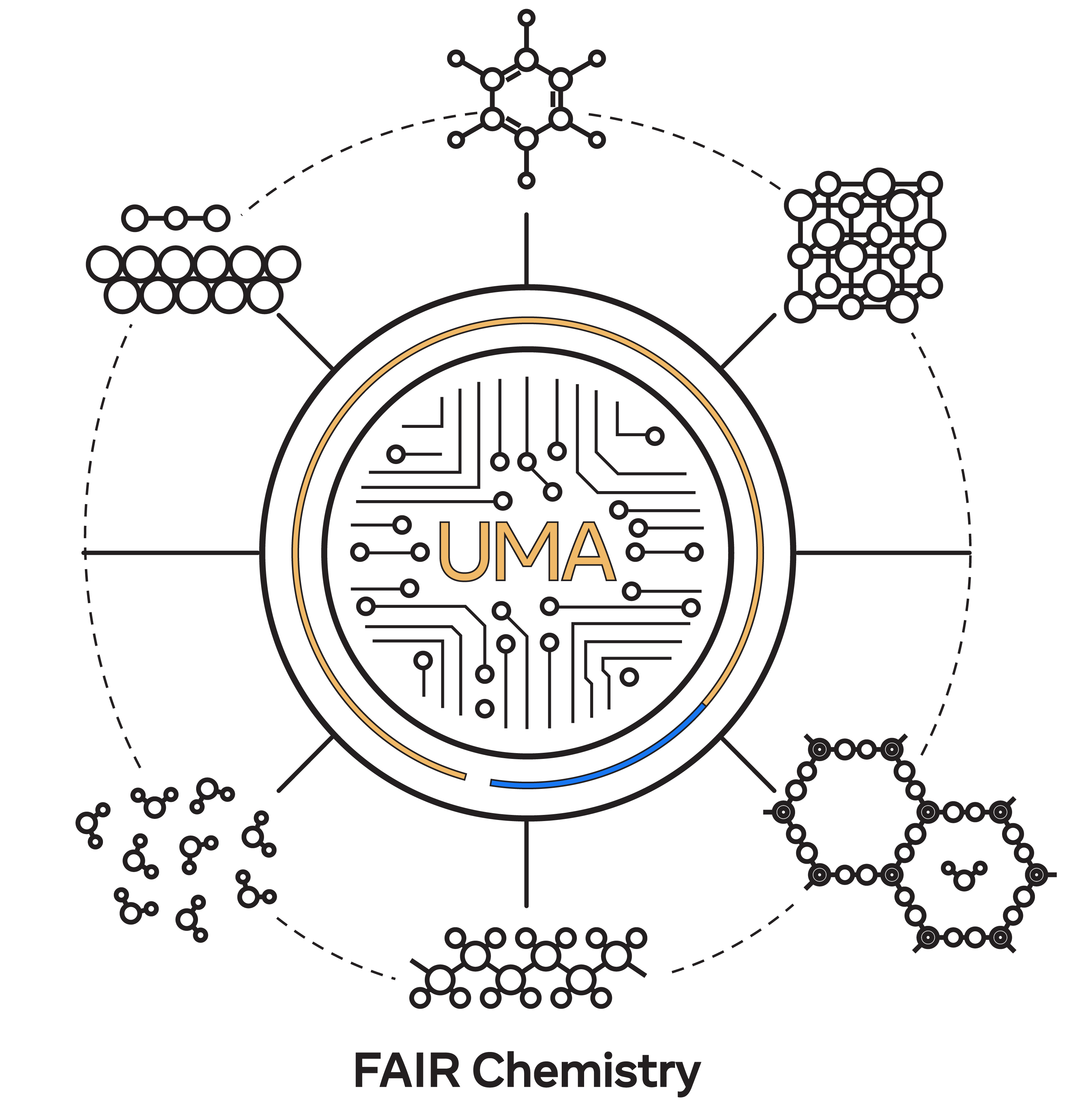
FAIR Chemistry provides three connected pieces:
Open datasets contain atomistic structures and DFT labels for distinct chemistry domains.
UMA is a family of Universal Models for Atoms pretrained across those domains.
fairchemconnects UMA to tools such as ASE, LAMMPS, and quacc for calculations and simulations.
One model, several tasks
Each dataset was calculated with a particular scientific method and set of approximations. UMA preserves those distinctions through a task input. You select the task that matches your system and the level of theory you want UMA to emulate.
| Domain | Representative training data | UMA task | Example uses |
|---|---|---|---|
| Organic molecules and polymers | OMol25 | omol | Conformers, reactions, molecular dynamics |
| Inorganic materials | OMat24 | omat | Relaxations, phonons, elastic properties |
| Heterogeneous catalysts | OC20, OC22, OC25 | oc20, oc22, oc25 | Adsorption, surfaces, reaction pathways |
| Molecular crystals | OMC25 | omc | Crystal packing and polymorph ranking |
| MOFs and direct air capture | ODAC23 | odac | CO₂ and H₂O adsorption |
Task selection matters because predictions from different tasks generally represent different DFT levels of theory. They should not be mixed in one energy comparison without careful validation. See the UMA model guide for task-specific caveats.
What you can do with UMA
UMA provides energies, forces, and—for supported periodic tasks—stresses through the standard ASE calculator interface. Those predictions can drive many atomistic workflows without changing models as you move between domains.
omolCalculate conformer energies, spin gaps, vibrations, and molecular dynamics.
omatRelax atomic positions and cells, calculate elastic properties, and construct phonon spectra.
oc20, oc22, oc25Study adsorption, surface stability, reaction thermochemistry, and transition states with the task appropriate to the interface.
omcScore periodic molecular crystals and support crystal-structure prediction workflows.
odacEstimate adsorption energies and study framework deformation for CO₂ and H₂O.
Use batched inference, multiple GPUs, LAMMPS, or workflow engines for larger and more numerous simulations.
A typical workflow
Install
fairchem-coreand obtain access to the gated UMA repository.Create or load an atomic structure as an ASE
Atomsobject.Load
uma-s-1p2p1and select the appropriate task.Attach a
FAIRChemCalculatorto the structure.Run an energy, force, relaxation, dynamics, or downstream-property calculation.
Inspect the structure and validate important conclusions against reference data or higher-fidelity calculations.
Try UMA without writing code
The Meta AI Demo Lab UMA playground is the recommended browser-based experience. Use it to manipulate structures and build intuition before setting up a local workflow.
The separate guided UMA demo contains additional worked examples and is maintained outside this repository.