Open data and universal models for atomic systems
FAIR Chemistry develops open datasets and machine-learning models for molecules, materials, and catalysts. UMA brings these domains together in one pretrained model while preserving each dataset’s level of theory.
pip install fairchem-coreFrom open datasets to UMA
UMA learns from more than 500 million density functional theory calculations. At inference time, you choose a task that matches your chemistry domain and the corresponding level of theory.

Surface reactions, adsorption, and catalyst design.
Bulk materials, phonons, and elastic properties.
Conformers, reactions, and electronic properties.

Packed organic molecules in crystal structures.
CO₂ and H₂O adsorption in metal-organic frameworks.
UMA uses a learned task embedding to apply one pretrained model across these
domains without mixing their reference methods. Start with
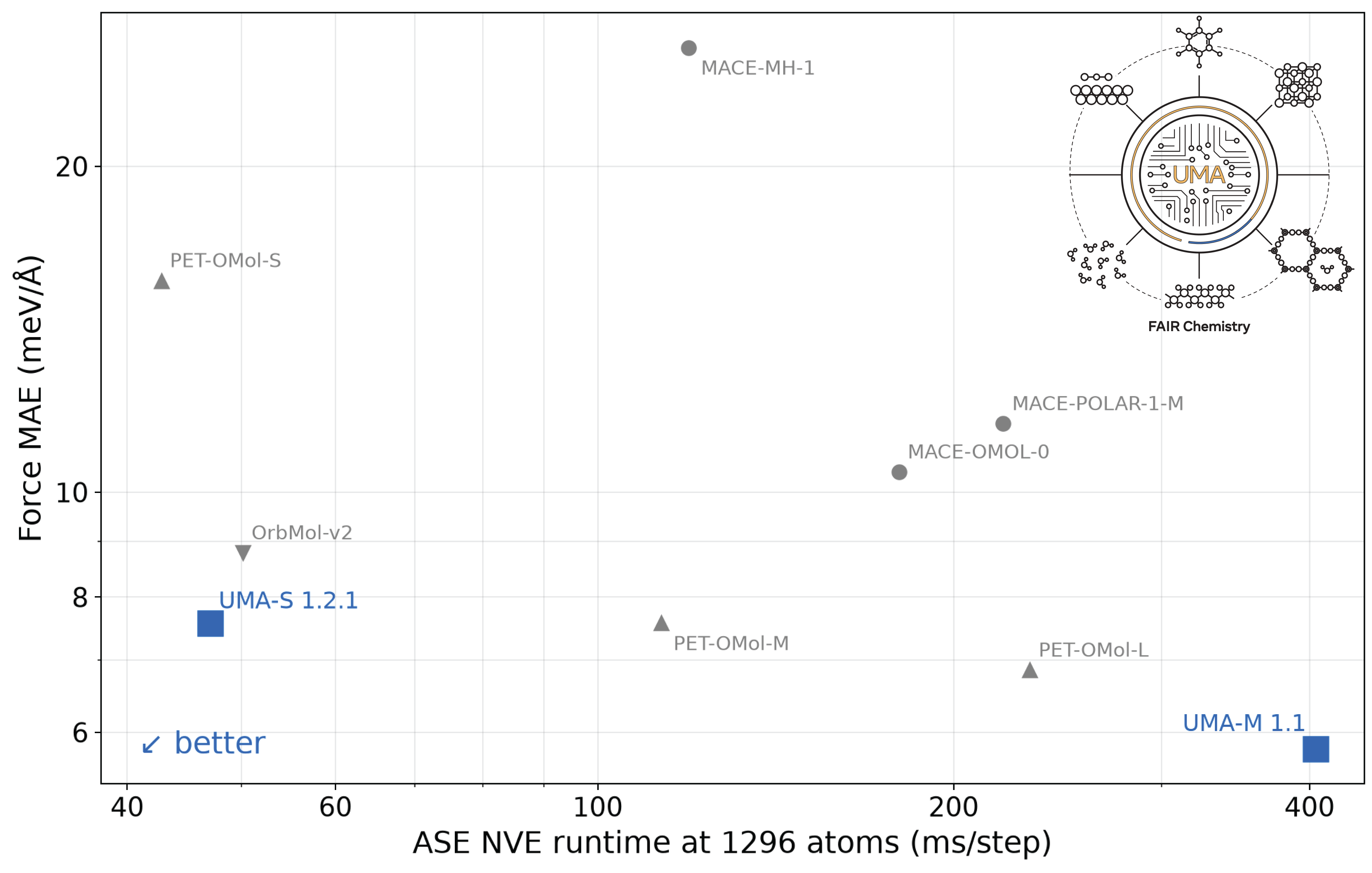
uma-s-1p2p1, the fastest current UMA model with
state-of-the-art accuracy on most supported benchmarks.
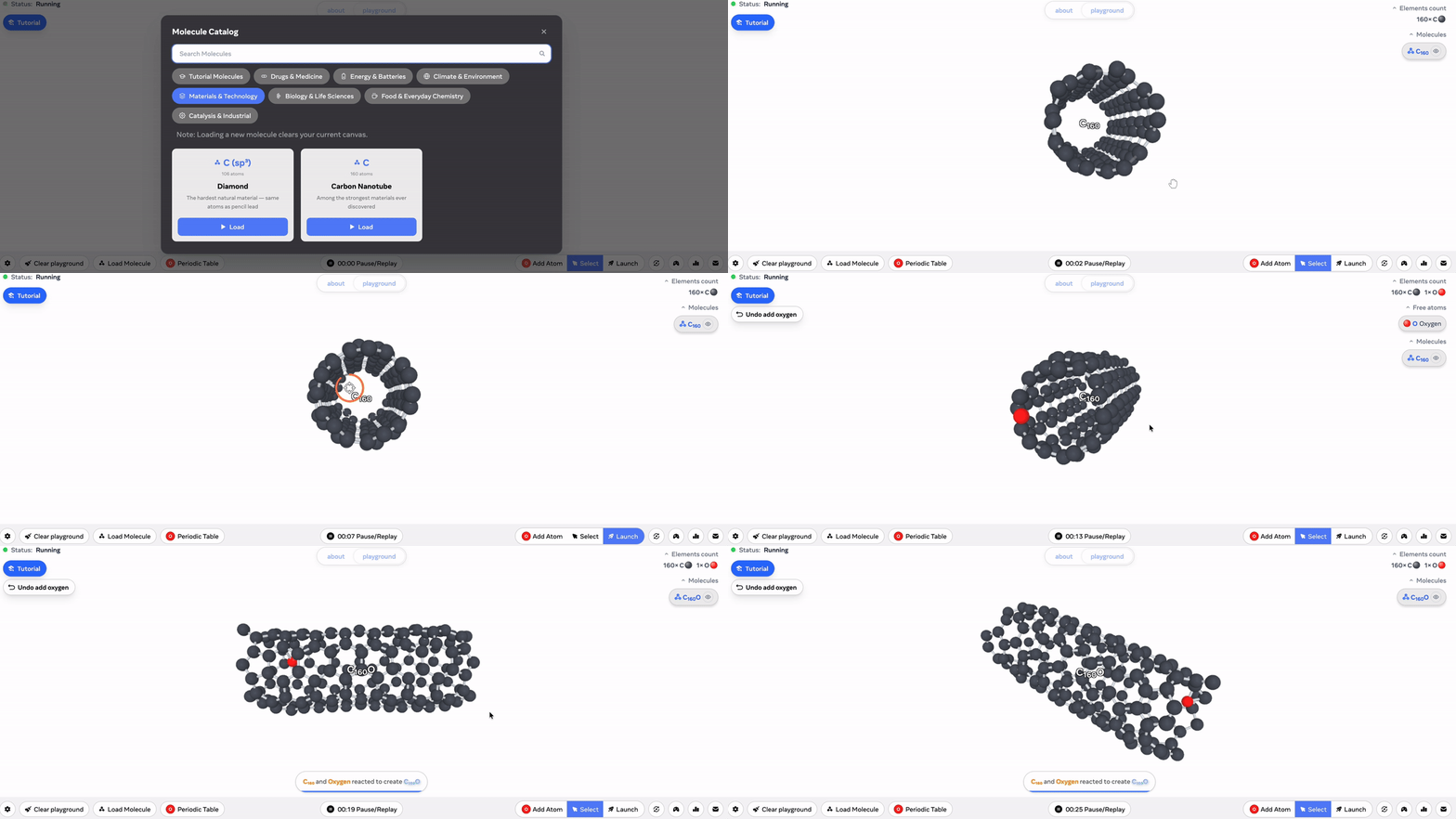
See what UMA can do
Choose your next step
Set up fairchem-core and request access to UMA checkpoints.
Run a molecular calculation and relax an inorganic crystal.
Find the right task and workflow for your scientific problem.
Understand UMA tasks, inputs, architecture, and limitations.
Scale from ASE calculations to training and batched inference.
Watch introductory videos and technical presentations.
Copyright © Meta Platforms, Inc | Terms of Use | Privacy Policy