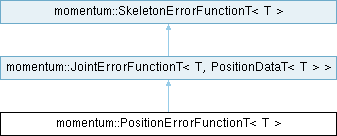
The PositionErrorFunction computes the 3D positional errors from a list of Constraints. More...
#include <position_error_function.h>
Public Member Functions | |
| PositionErrorFunctionT (const Skeleton &skel, const ParameterTransform &pt, const T &lossAlpha=GeneralizedLossT< T >::kL2, const T &lossC=T(1)) | |
| Constructor. | |
| PositionErrorFunctionT (const Character &character, const T &lossAlpha=GeneralizedLossT< T >::kL2, const T &lossC=T(1)) | |
| A convenience api where character contains info of the skeleton and parameter transform. | |
| Public Member Functions inherited from momentum::JointErrorFunctionT< T, PositionDataT< T > > | |
| JointErrorFunctionT (const Skeleton &skel, const ParameterTransform &pt, const T &lossAlpha=GeneralizedLossT< T >::kL2, const T &lossC=T(1)) | |
| Constructor. | |
| double | getError (const ModelParametersT< T > ¶ms, const SkeletonStateT< T > &state, const MeshStateT< T > &meshState) final |
| Computes the error function value l = w * loss(f^2). | |
| double | getGradient (const ModelParametersT< T > ¶ms, const SkeletonStateT< T > &state, const MeshStateT< T > &meshState, Ref< VectorX< T > > gradient) final |
| The gradient of the error function: dl/dq = dl/d[f^2] * 2f * df/dv * dv/dq. | |
| double | getJacobian (const ModelParametersT< T > ¶ms, const SkeletonStateT< T > &state, const MeshStateT< T > &meshState, Ref< MatrixX< T > > jacobian, Ref< VectorX< T > > residual, int &usedRows) final |
| For least-square problems, we assume l is the square of a vector function F. | |
| size_t | getJacobianSize () const final |
| The number of rows in the jacobian is the dimension of f, FuncDim, times the number of constraints. | |
| void | addConstraint (const PositionDataT< T > &constr) |
| Adds a constraint to the list. | |
| void | addConstraints (std::span< const PositionDataT< T > > constrs) |
| Appends a list of constraints. | |
| void | setConstraints (std::span< const PositionDataT< T > > constrs) |
| Replace the current list of constraints with the input. | |
| const std::vector< PositionDataT< T > > & | getConstraints () const |
| size_t | getNumConstraints () const |
| void | clearConstraints () |
| Clear the current list of constraints. | |
| PositionDataT< T > & | getConstraint (size_t index) |
| Mutable access to a constraint by index, for in-place updates. | |
| Public Member Functions inherited from momentum::SkeletonErrorFunctionT< T > | |
| SkeletonErrorFunctionT (const Skeleton &skel, const ParameterTransform &pt) | |
| virtual | ~SkeletonErrorFunctionT ()=default |
| const Skeleton & | getSkeleton () const |
| const ParameterTransform & | getParameterTransform () const |
| virtual const Character * | getCharacter () const |
| For mesh-based error functions, get access to the underlying character. | |
| void | setWeight (T w) |
| T | getWeight () const |
| void | setActiveJoints (const VectorX< bool > &aj) |
| void | setEnabledParameters (const ParameterSet &ps) |
| virtual double | getGradient (const ModelParametersT< T > &, const SkeletonStateT< T > &, const MeshStateT< T > &, Eigen::Ref< Eigen::VectorX< T > >) |
| virtual double | getJacobian (const ModelParametersT< T > &, const SkeletonStateT< T > &, const MeshStateT< T > &, Eigen::Ref< Eigen::MatrixX< T > >, Eigen::Ref< Eigen::VectorX< T > >, int &usedRows) |
| virtual void | getHessian (const ModelParametersT< T > &, const SkeletonStateT< T > &, const MeshStateT< T > &, Eigen::Ref< Eigen::MatrixX< T > >) |
| virtual double | getSolverDerivatives (const ModelParametersT< T > ¶meters, const SkeletonStateT< T > &state, const MeshStateT< T > &meshState, const size_t actualParameters, Eigen::MatrixX< T > &hess, Eigen::VectorX< T > &grad) |
| virtual bool | needsMesh () const |
Static Public Attributes | |
| static constexpr T | kLegacyWeight = 1e-4 |
| Default constant weight in MarkerErrorFunction. | |
| Static Public Attributes inherited from momentum::JointErrorFunctionT< T, PositionDataT< T > > | |
| static constexpr size_t | kFuncDim |
| static constexpr size_t | kNumVec |
| static constexpr size_t | kNumPos |
Protected Member Functions | |
| void | evalFunction (size_t constrIndex, const JointStateT< T > &state, Vector3< T > &f, std::array< Vector3< T >, 1 > &v, std::array< Matrix3< T >, 1 > &dfdv) const final |
| Protected Member Functions inherited from momentum::JointErrorFunctionT< T, PositionDataT< T > > | |
| virtual void | evalFunction (size_t constrIndex, const JointStateT< T > &state, FuncType &f, std::array< VType, 1 > &v, std::array< DfdvType, 1 > &dfdv) const=0 |
| Evaluate the constraint residual and derivatives for a single constraint. | |
Additional Inherited Members | |
| Public Types inherited from momentum::JointErrorFunctionT< T, PositionDataT< T > > | |
| using | FuncType |
| using | VType |
| using | DfdvType |
| Protected Attributes inherited from momentum::JointErrorFunctionT< T, PositionDataT< T > > | |
| std::vector< PositionDataT< T > > | constraints_ |
| List of constraints. | |
| const GeneralizedLossT< T > | loss_ |
| The generalized loss function that transforms f^2. | |
| VectorX< T > | jointGrad_ |
| Intermediate storage of the gradient from this error function. | |
| Protected Attributes inherited from momentum::SkeletonErrorFunctionT< T > | |
| const Skeleton & | skeleton_ |
| const ParameterTransform & | parameterTransform_ |
| T | weight_ |
| VectorX< bool > | activeJointParams_ |
| ParameterSet | enabledParameters_ |
| bool | useHessian_ {false} |
Detailed Description
class momentum::PositionErrorFunctionT< T >
The PositionErrorFunction computes the 3D positional errors from a list of Constraints.
Each constraint specifies a locator on the skeleton (parent joint and offset), and its target 3D position.
Definition at line 35 of file position_error_function.h.
Constructor & Destructor Documentation
◆ PositionErrorFunctionT() [1/2]
|
inlineexplicit |
Constructor.
- Parameters
-
[in] skel character skeleton [in] pt character parameter transformation [in] lossAlpha alpha parameter for the loss function [in] lossC c parameter for the loss function
Definition at line 43 of file position_error_function.h.
◆ PositionErrorFunctionT() [2/2]
|
inlineexplicit |
A convenience api where character contains info of the skeleton and parameter transform.
- Parameters
-
[in] character character definition [in] lossAlpha alpha parameter for the loss function [in] lossC c parameter for the loss function
Definition at line 55 of file position_error_function.h.
Member Function Documentation
◆ evalFunction()
|
finalprotected |
Member Data Documentation
◆ kLegacyWeight
|
staticconstexpr |
Default constant weight in MarkerErrorFunction.
This can be used for backwards compatibility in setWeight().
Definition at line 64 of file position_error_function.h.
The documentation for this class was generated from the following files:
- character_solver/fwd.h
- character_solver/position_error_function.h
- character_solver/position_error_function.cpp
