spdl.io.transfer_tensor_h2d
- transfer_tensor_h2d(batch: T, /, *, num_caches: int = 4) T[source]
Transfer PyTorch tensors from CPU to CUDA in a dedicated stream.
Added in version 0.8.0.
Changed in version 0.9.0: Recursive failures drain submitted copies before unwinding. Failed drains retain source/destination owners until completion is proved. Returned GPU destinations are recorded on the selected device’s default consumer stream; callers using other streams retain normal readiness/recording responsibilities.
This function wraps calls to
torch.Tensor.pin_memory()andtorch.Tensor.to(), and executes them in a dedicated CUDA stream.When called in a background thread, the data transfer overlaps with the GPU computation happening in the foreground thread (such as training and inference).
See also
Multi-threading (custom) - An intended way to use this function in
Pipeline.benchmark_pinned_arena- Matched public pool/ring pinning comparisons through subprocess iteration and synchronized H2D wall time, with archival earlier measurements.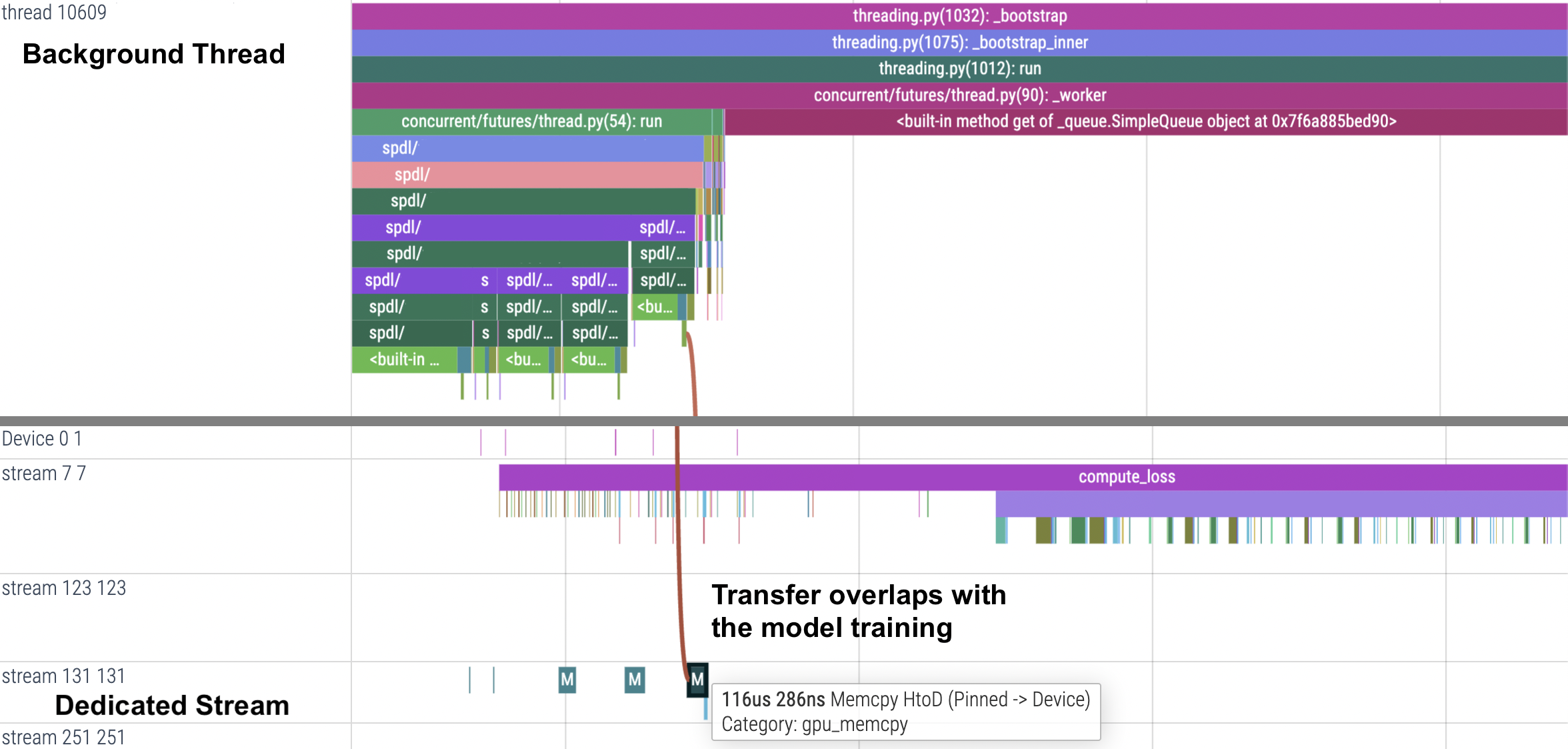
Concretely, it performs the following operations.
If a dedicated CUDA stream local to the calling thread is not found in thread-local storage, creates and caches one. (The target device is determined by the
"LOCAL_RANK"environment variable.)Activates the CUDA stream.
Traverses the given object recursively and transfers CPU tensors to CUDA.
pin_memoryreuses source storage when Torch recognizes it as pinned; otherwise it creates a page-locked copy. CUDA transfer is submitted with.to(non_blocking=True).Synchronizes the stream, to ensure that all the data transfers are completed.
- Parameters:
batch – A
torch.Tensoror a composition of tensors with container types such aslist,tuple,dictanddataclass.num_caches –
Number of batch caches to maintain the reference to. This parameter helps mitigate race conditions when using multi-threading with multiple CUDA streams.
See PyTorch CUDA Race Condition in Multi-threading for details on the rationale behind this parameter.
- Returns:
An object of the same type as the input, but the PyTorch tensors are transferred to CUDA device.
Example
from concurrent.futures import ThreadPoolExecutor

from spdl.io import transfer_tensor_h2d

with ThreadPoolExecutor(max_workers=1) as executor:
    future = executor.submit(transfer_tensor_h2d, cpu_batch)
    cuda_batch = future.result()