Point tracking
~20K 3D tracks per sequenceLabelled as body, clothing, carried object, or scene, with visibility per camera.
1Meta Reality Labs 2Visual Geometry Group, University of Oxford 3Princeton University
For object interaction, details matter. That is why we provide high-resolution images with dense annotations across cameras.
Five modalities next to the RGB frame, all pixel-aligned: depth, segmentation, forward flow, point tracks, and 3D boxes. Select one to see it on its own. Camera: body_follow, 1920 × 1080, pinhole.
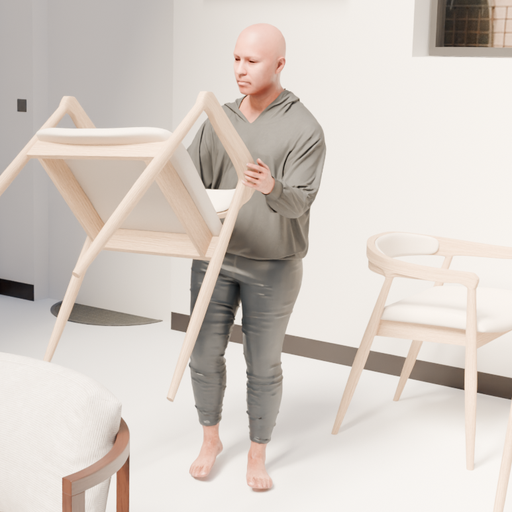
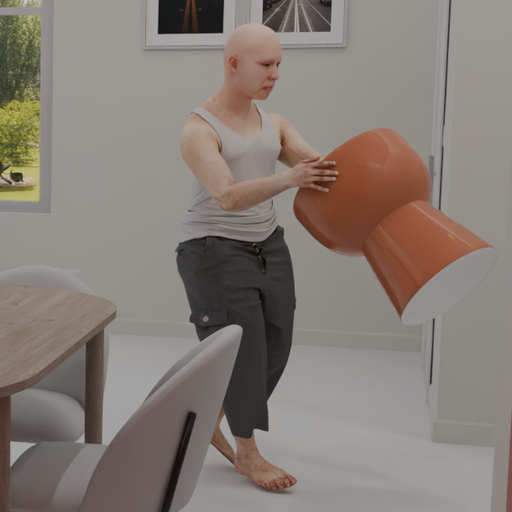
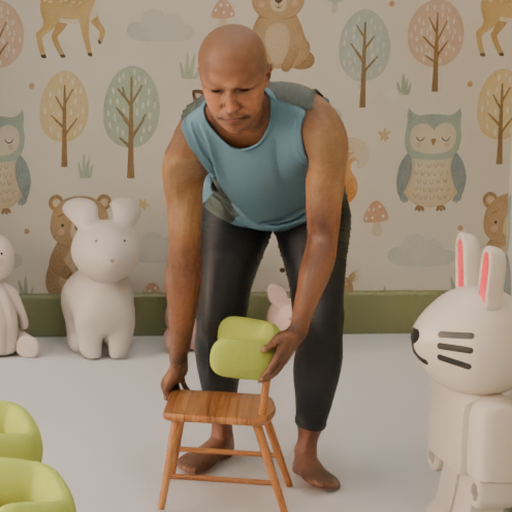
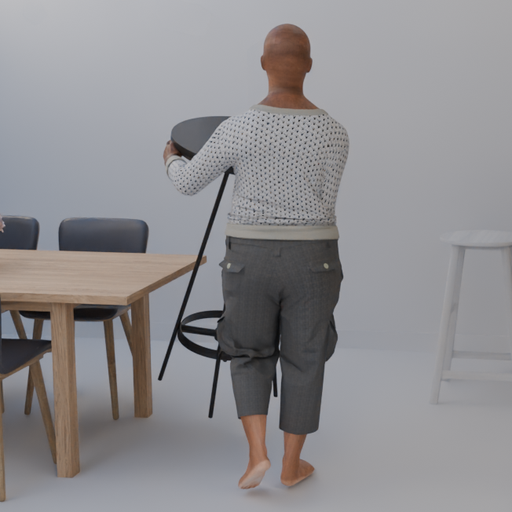
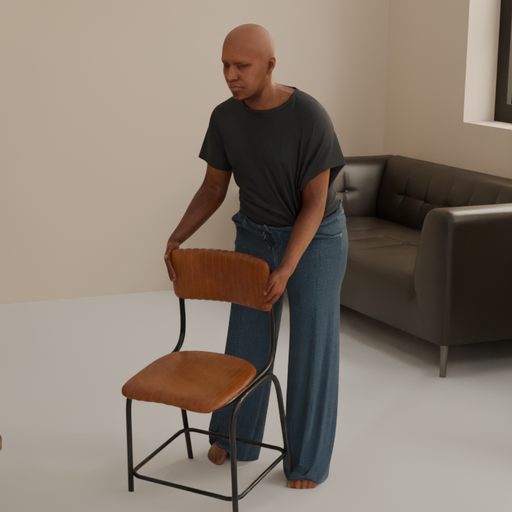
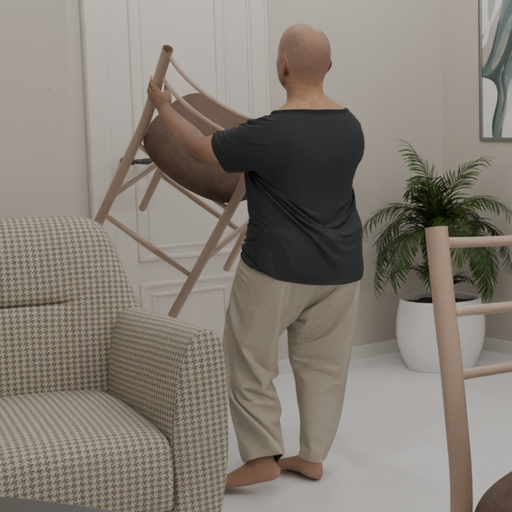
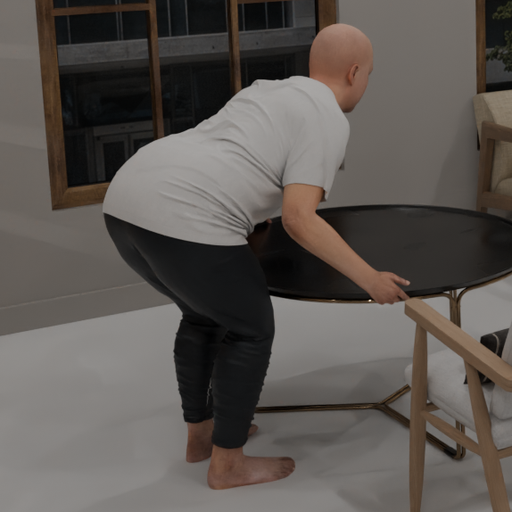
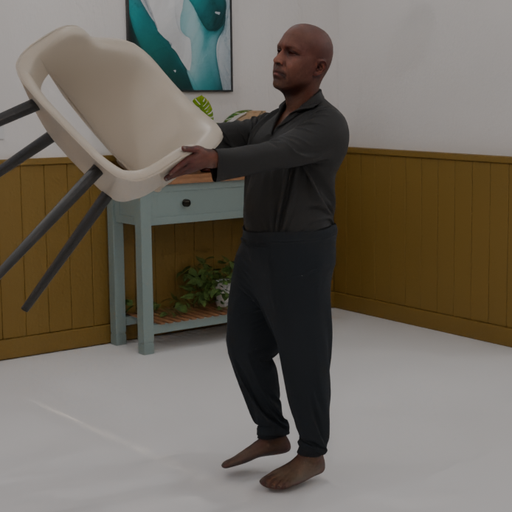
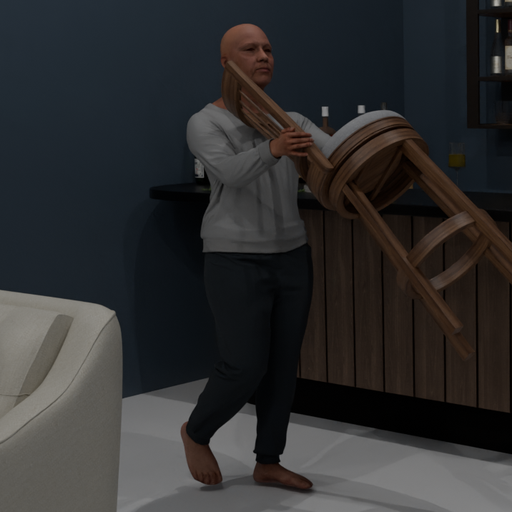
Prior synthetic datasets tend to specialize either on human body motion or on rigid object dynamics. Schlepp covers the intersection, with sequences of people grasping, carrying, and placing objects in furnished indoor scenes.
| Type | Frames | Cameras | Ego + Exo | HOI | Multi-actor | Sim. cloth | Dense flow | Point tracks | Dense depth | 3D body + obj poses | |
|---|---|---|---|---|---|---|---|---|---|---|---|
| Spring | Sim | 6K | 2 | – | ✓ | ✓ | ✓ | ✓ | – | ✓ | – |
| Hypersim | Sim | 77K | 1 | – | – | – | – | – | – | ✓ | Obj only |
| PointOdyssey | Sim | 208K | 1 | – | – | ✓ | – | – | ✓ | ✓ | Body only |
| Kubric (MOVi) | Sim | 1.2M | 1 | – | – | – | – | ✓ | ✓ | ✓ | Obj only |
| Syn4D | Sim | 1.4M | 8 | – | – | – | ✓ | ✓ | ✓ | ✓ | Body only |
| BEDLAM 2.0 | Sim | 8M | 1 | – | – | ✓ | ✓ | – | – | Partial | Body only |
| NymeriaPlus | Real | >30M | Multi | ✓ | ✓ | ✓ | Real | – | – | – | MHR + OBB |
| Ego-Exo4D | Real | >100M | 5–6 | ✓ | ✓ | ✓ | Real | – | – | – | Body only |
| Schlepp | Sim | 2.2M | 6 | ✓ | ✓ | ✓ | ✓ | ✓ | ✓ | ✓ | MHR + OBB |
Labelled as body, clothing, carried object, or scene, with visibility per camera.
At full RGB resolution, with occlusion masks from depth.
Furnished indoor scenes with people carrying objects; invalid pixels such as windows are masked.
Three exocentric and three egocentric, with full intrinsics and extrinsics at metric scale.
Several actors per scene, often occluding each other and the furniture.
Fully annotated scenes, where carried objects move every frame.
Schlepp was created by distilling motion from video models. The generated videos are set in existing 3D scenes where we replicate and align the motion.
Goal
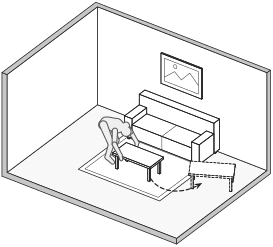
We want to generate a person picking up an object, moving with it inside the room, and placing it down somewhere else. As we want to use arbitrary objects and scenes, we do not want to rely on motion capture data.
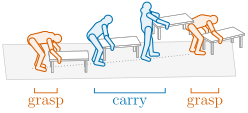
We query a video model for the two components that make up a carry sequence separately. This makes 2D-3D alignment more feasible, reduces prompt complexity, and limits motion reconstruction errors.
Contact pose
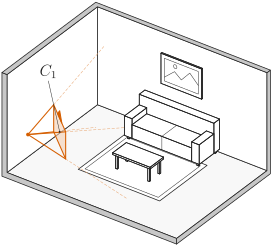
We place a camera C1 that frames the desired object in an artist-made 3D room, which will stage our motion sequence.
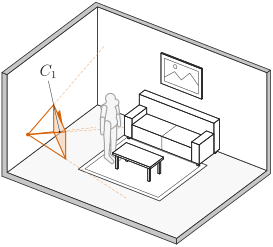
We add a randomized person in a neutral pose close to the target object. This fixes the person's scale, simplifying the pose and shape recovery.
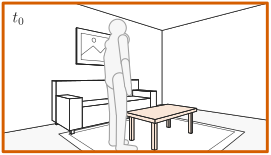
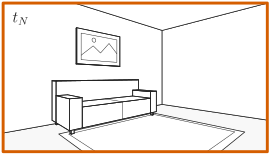
By removing the object, we nudge the model to have the human touch the object and carry it outside the frame, a sequence that naturally includes a grasp.
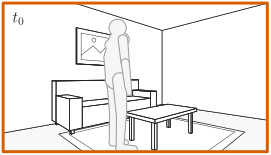
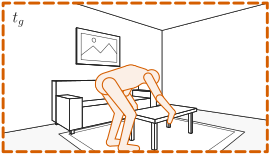
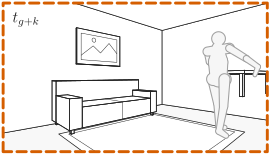
The video model completes the sequence, including a grasp frame tg, where the object is about to move. We discard the remaining frames.
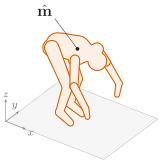
We estimate the body m in the grasp frame and refine it into the contact pose m⋆. We ensure that the person and grasp are in alignment with the 3D world.
Carry motion
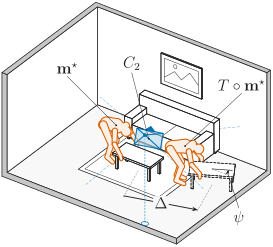
To tightly condition the sequence the video model needs to hallucinate, we define an end pose that reuses m⋆, translated by Δ and rotated by ψ (the transformation T). For better framing, we choose a new camera C2.
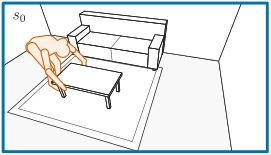
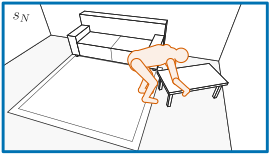
We render the start and end states from the new camera C2 as the first and last frames for the carry motion sequence.
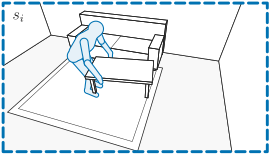
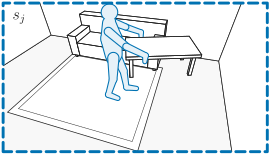
The video model produces a sequence of frames showing the lift, the walk, and the set-down.
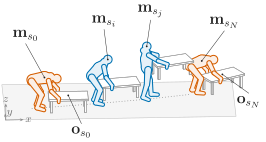
We extract the pose in every frame, smooth the motion, and "glue" the object to the hands. This eliminates tracking errors and plausibly matches real carrying motion.
Annotators reviewed every sequence that passed our automatic checks and judged whether the motion and the grasp look plausible. They accepted about 15.9K of 57.2K.
Every actor wears physically simulated garments and shows fabric motion under real body dynamics. Skin textures, body shapes, and clothing combinations are drawn from a diverse pool.
| Name | Resolution | Distortion |
|---|---|---|
static | 1920 × 1080 | pinhole |
body_follow | 1920 × 1080 | pinhole |
object_orbit | 1920 × 1080 | pinhole |
aria_rgb | 2016 × 1512 | KB4 |
aria_slamL | 512 × 512 | KB4 |
aria_slamR | 512 × 512 | KB4 |
[x, y, z, w].facebook/schlepphf download facebook/schlepp \
--repo-type dataset \
--local-dir /data/schlepp \
--include "*_static_rgb.tar" \
"*_bodyfollow_rgb.tar" \
"*_objectorbit_rgb.tar" \
"*_pointtracks.tar" \
"*_metadata.tar" \
"*.parquet"
git clone https://github.com/facebookresearch/schlepp.git
pip install -e schlepp
cd schlepp && python -m scripts.unpack_chunks /data/schleppOnly download the cameras and modalities you need. Chunks are stratified by carried-object category, so a partial download is still representative. Always include *_metadata.tar and *.parquet.
Then, pull the code and install the dependencies. To interface with the dataset, you'll need to unpack the chunks first.
facebookresearch/schleppfrom torch.utils.data import DataLoader
from schlepp import SchleppDataset
from schlepp.utils import resize_sample, subsample_tracks
def to_point_tracker(sample):
sample = resize_sample(sample, short_side=384)
pt = subsample_tracks(
sample["point_tracks"], 512, mode="stratified",
)
cam = sample["cameras"]["body_follow"]
return (
cam["rgb"].permute(0, 2, 3, 1), # (S, H, W, 3)
pt["trajs_2d_pix"]["body_follow"], # (S, 512, 2)
pt["visible"]["body_follow"], # (S, 512)
)
ds = SchleppDataset(
"/data/schlepp",
modalities=["rgb", "point_tracks"],
cameras="body_follow",
seq_len=24,
transform=to_point_tracker,
)
loader = DataLoader(ds, batch_size=4, num_workers=8)
for rgbs, trajs, visibs in loader:
... # train your point trackerExample code to train a point tracker. We provide a Dataset class for Schlepp, which gets you quickly up and running. See the README for full recipes for flow, depth, pose, MHR, and OBB tasks, plus the bundled evaluation and visualisation tools.
@inproceedings{engstler2026schlepp,
  title     = {Schlepp: A Multi-View Synthetic Dataset of Humans Carrying Objects},
  author    = {Engstler, Paul and Wang, Yihan and Aubel, Amaury and Deshmukh, Priyamvad and
               Segev, Shai and Li, Zhengqin and Barnes, Dan and Rupprecht, Christian and
               Siddiqui, Yawar and Ma, Lingni and Straub, Julian and Dong, Zhao and
               Newcombe, Richard and Vedaldi, Andrea and Engel, Jakob and Harley, Adam W.},
  booktitle = {TBD},
  year      = {2026},
}