Unified Post-Training via On-Policy-Trained Language Model as a Reward Model
Our Contribution
We develop RLLM, a framework for reinforcement learning (RL) that unifies the post-training paradigm, enabling the policy model to excel across easy-to-verify, hard-to-verify, and non-verifiable tasks.
Reinforcement Learning with an LM as Reward Model (RLLM) first trains an LM-as-RM on on-policy synthetic judgments using RL and uses its generative rewards to optimize the policy itself.
The LM-as-RM exploits an LLM’s:
- (1) reasoning capabilities to produce higher-quality reward signals and
- (2) instruction-following capabilities to allow flexible reward design.
We show that training the RLLM reward model on-policy (via responses sampled from the policy model) yields improved results.
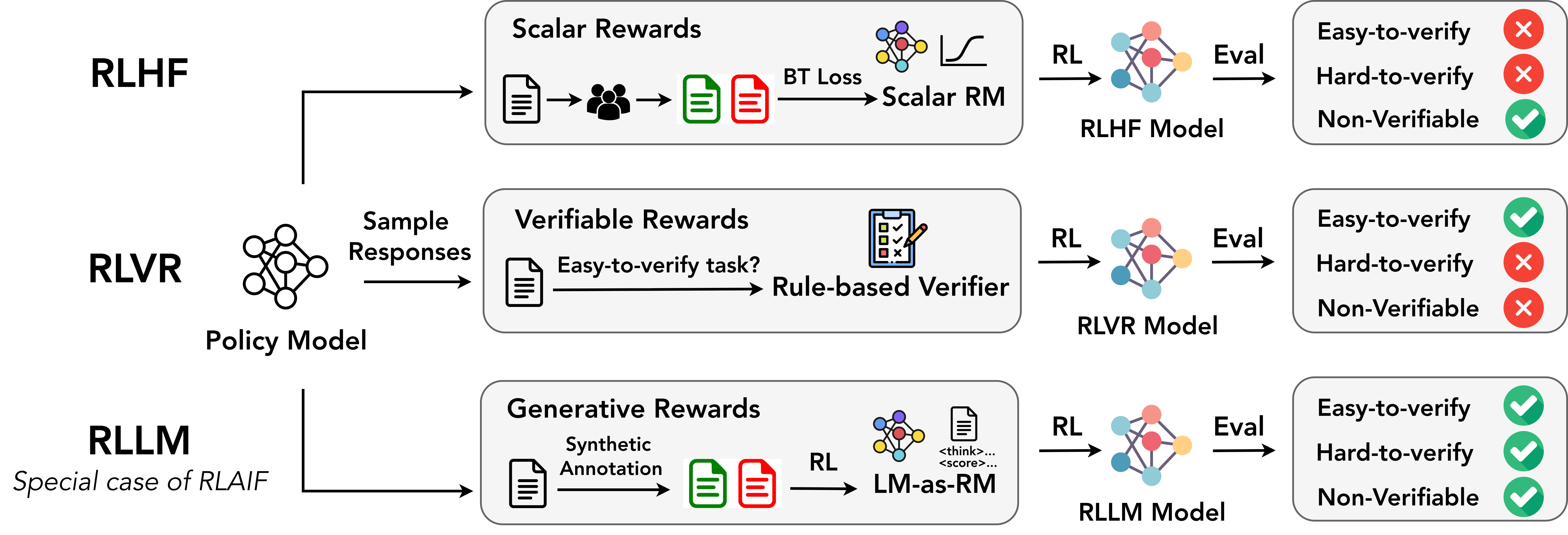
Figure: Reinforcement Learning with an LM as Reward Model (RLLM) method compared to standard RLHF and RLVR approaches for post-training LLMs.
Why This Matters
Post-training for LLMs typically follows one of two paradigms: Reinforcement Learning from Human Feedback (RLHF), which relies on scalar reward models trained from human preference data, or Reinforcement Learning with Verifiable Rewards (RLVR), which depends on rule-based verifiers. Scalar reward models do not generate chain-of-thought reasoning, making them prone to reward hacking and limiting their effectiveness on complex reasoning tasks. Rule-based verifiers, meanwhile, assume access to gold answers that can be both hard-to-obtain and hard-to-verify, limiting their utility to e.g. easily-verifiable math and code problems.
We show that RLLM can serve as a single, unified post-training recipe, enabling the policy model to excel across easy-to-verify, hard-to-verify, and non-verifiable tasks.
Further, we show that on-policy training of the LM-as-RM outperforms both prompted LMs-as-RMs (including a larger GPT-OSS-120B) and off-policy trained ones. Finally, through extensive analyses across a wide range of policy–reward LM pairings – varying in model size, capability, and training data (easy- vs. hard-to-verify, reference-free vs. reference-based tasks) – we identify the key ingredients for effective post-training with Language Models as Reward Models.
How does it work?
Modern LLM post-training is increasingly framed as a reinforcement learning (RL) problem. But the source of reward—what tells the model what is “good”—has evolved significantly. In this work we emphasize the transition toward RLLM as a more general and flexible approach: use LLMs themselves as evaluators.
This falls under Reinforcement Learning from AI Feedback (RLAIF), but we focus on a specific setting. Instead of a scalar reward model (RLHF), or a hard verifier (RLVR), we use a “thinking” LLM to generate rewards, which is itself trained by on-policy RL. Notably, recent rubric-based evaluation methods – where structured criteria guide judgment – can be viewed as a special case within our framework: the LM-as-RM implicitly internalizes and flexibly applies such rubrics through its reasoning, without requiring explicitly specified scoring rules.
This allows the model to reason about the response, compare alternatives, use context or references, and produce structured judgments – and this thinking is trained with respect to the policy itself.
RLLM training still follows a standard RL objective:
\[\max_{\pi_{\theta}} \mathbb{E}_{x \sim \mathcal{D}, y \sim \pi(\cdot|x)} [ r_{\text{LM}}(x, y) ] - \beta \mathbb{D}_{\text{KL}}(\pi_{\theta} || \pi_{\text{ref}})\]Where:
- $r_{\text{LM}}(x, y)$ is the LM-as-RM, $\pi_{\theta}$ is the current policy, $\pi_{\text{ref}}$ is the reference model and $\beta$ = KL penalty (controls drift).
A key distinction however is that RLLM uses RL twice:
- To train the LM-as-RM. In particular we wish to train this as on-policy as possible wrt the responses from the LM.
- To train the policy using that LM.
LM-as-RM training
For LM-as-RM training we follow the J1 recipe, except that we will show that on-policy training is crucial for strong performance.
In this recipe, training data is constructed as synthetic judgment tasks with labels, converting diverse tasks into a unified verifiable format compatible with RLVR-style training.
LM-as-RM Synthetic Training Data Generation.
Let $\pi_{\theta_\text{policy}}$ denote the initial policy LLM that we want to optimize using an LM-as-RM.
To train the LM-as-RM, we first sample on-policy responses from $\pi_{\theta_\text{policy}}$ and synthetically annotate the responses for the reward modeling task. Specifically, given a dataset $\mathcal{D}$ with instructions $x$ and optionally available reference answers $y_{\mathrm{ref}}$, we generate reward model training data in three steps:
- (i) sample a set of responses $\mathbf{y}$ from the policy $\pi_{\theta_\text{policy}}$;
- (ii) employ a strong teacher LLM to rate the correctness or quality of these responses, obtaining scores $\mathbf{s}$. For mathematical reasoning tasks, these ratings are typically binary (correct/incorrect); for non-verifiable tasks, the scores span a continuous scale $[s_{\mathrm{min}}, s_{\mathrm{max}}]$ reflecting response quality.
- Finally, we create a balanced dataset to ensure a uniform distribution over the assigned scores.
LM-as-RM RLVR
Given the scores, we now train the LM-as-RM using RLVR. We format examples from the synthetic dataset $\mathcal{D}_{\text{LM}}$ into seed LM-as-RM prompts (depending on the training configuration), and instruct the model to generate a judgment $(t’, s’)$, consisting of a reasoning trace $t’$ and a predicted score $s’$.
We then optimize the model using GRPO, assigning a reward of $1$ if the predicted score matches the teacher score, and $0$ otherwise.
Flexible Rewarding: Beyond Scalars and Binary Signals
Unlike RLHF and RLVR, RLLM supports:
- Different evaluation modes: Pointwise (score a single response), Pairwise, and Listwise ranking multiple candidates
- Different inputs: reference-free and reference-based (tasks with a given reference answer).
- Task spectrum: Verifiable vs Non-Verifiable
Hence, RLLM is designed to unify training across verifiable tasks (math, code, structured reasoning) and non-verifiable tasks (open-ended chat, writing, alignment). This is a good property because most real-world LLM use cases are not easily verifiable.
Main Experimental Results
We perform a number of experiments across different settings and backbones for both the LM and the LM-as-RM.
Overall, across all these settings, RLLM achieves consistently higher accuracy and win rates than RLVR and RLHF, with particularly large gains when trained on hard-to-verify problems.
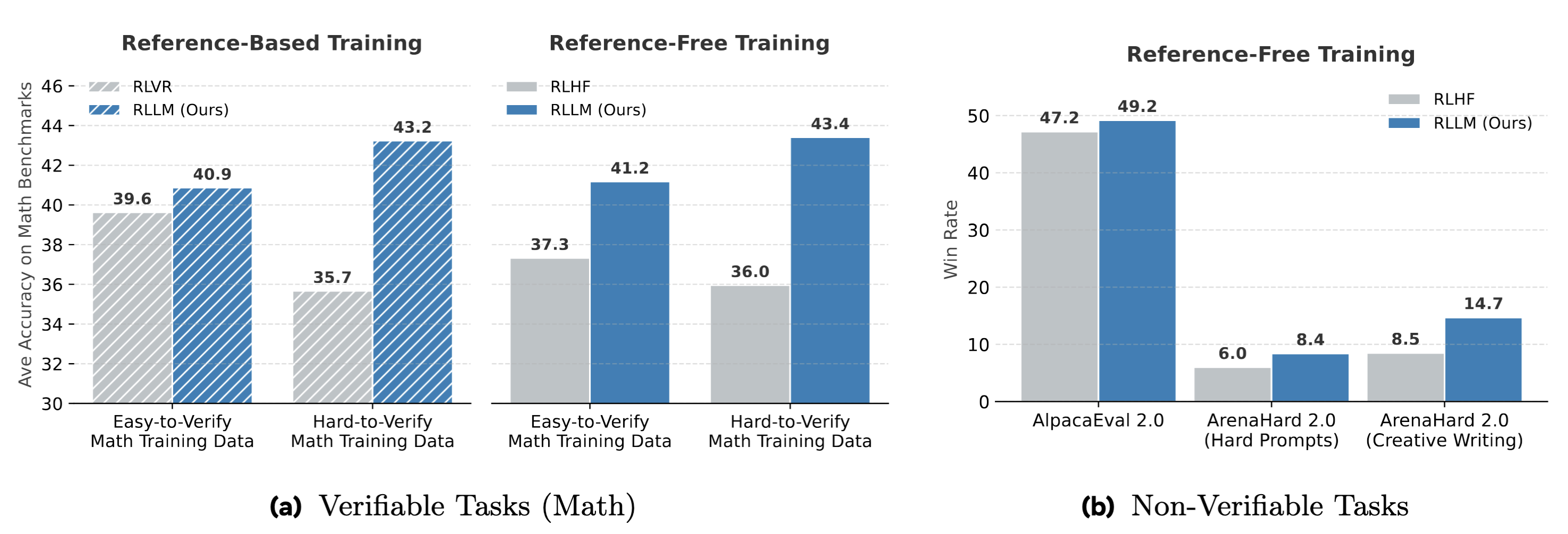
Figure: Performance comparison of post-trained Qwen3-1.7B models on (a) verifiable tasks (average of five math benchmarks) and (b) non-verifiable instruction-following tasks. Models are trained via RLHF (with *Skywork-Reward-V2-Llama-3.1-8B as scalar-RM), RLVR (with Math-Verify as rule-based verifier) and, our RLLM (with J1-Qwen3-32B as LM-as-RM). Post-training data for verifiable tasks is either (1) easy-to-verify, (2) hard-to-verify, (3) reference-free, or (4) reference-based.*
Let’s dig a little deeper into the results.
Reference-free setting
We conduct experiments where we compare post-trained Qwen3-1.7B (Instruct) models using RLLM or RLHF on easy-to-verify and hard-to-verify reasoning benchmarks in the reference-free setting. All models are trained on hard-to-verify samples. RLHF’ed models are optimized using SOTA scalar RMs. RLLM models are optimized using either prompted LM-as-RM or our trained J1 LM-as-RM. We observe improved RLLM results by scaling up the LM-as-RM, with J1-Qwen3-32B-RM improving AIME24 by 12\% on top of a Qwen3-1.7B (Instruct) model.
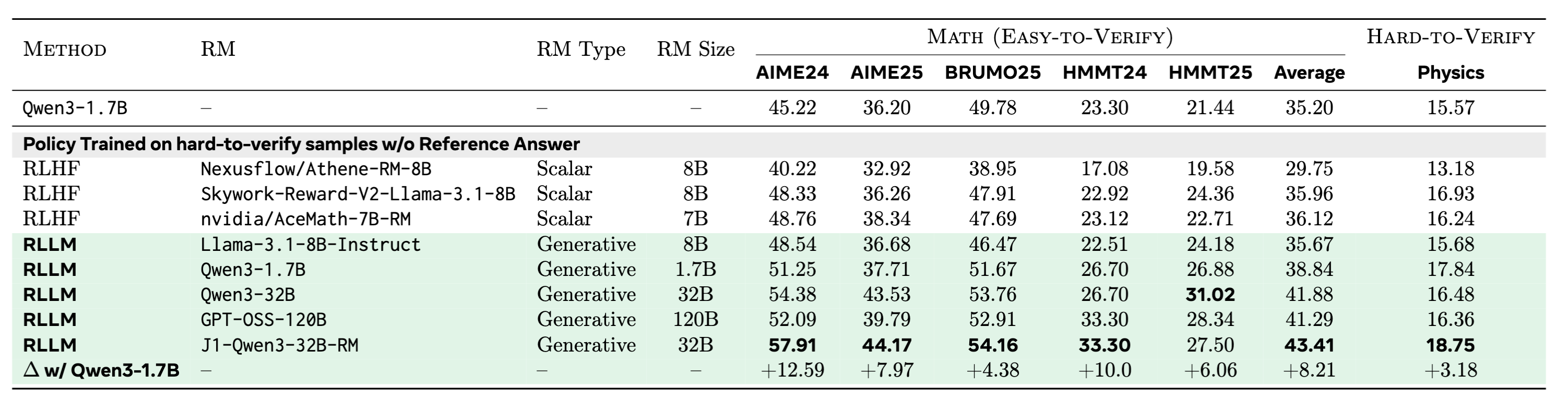 Figure: Reference-free setting. RLLM provides strong results compared to RLHF.
Reference-based setting
We compare post-trained Qwen3-1.7B (Instruct) models using RLLM or RLVR on easy-to-verify and hard-to-verify reasoning benchmarks in the referenced-based setting. All models are trained on hard-to-verify examples. RLVR models are optimized using either rule-based or model-based verifiers. RLLM models are optimized using either prompted or trained LM-as-RM (functioning as reference-based verifiers). All RLLM variants outperform all RLVR variants.
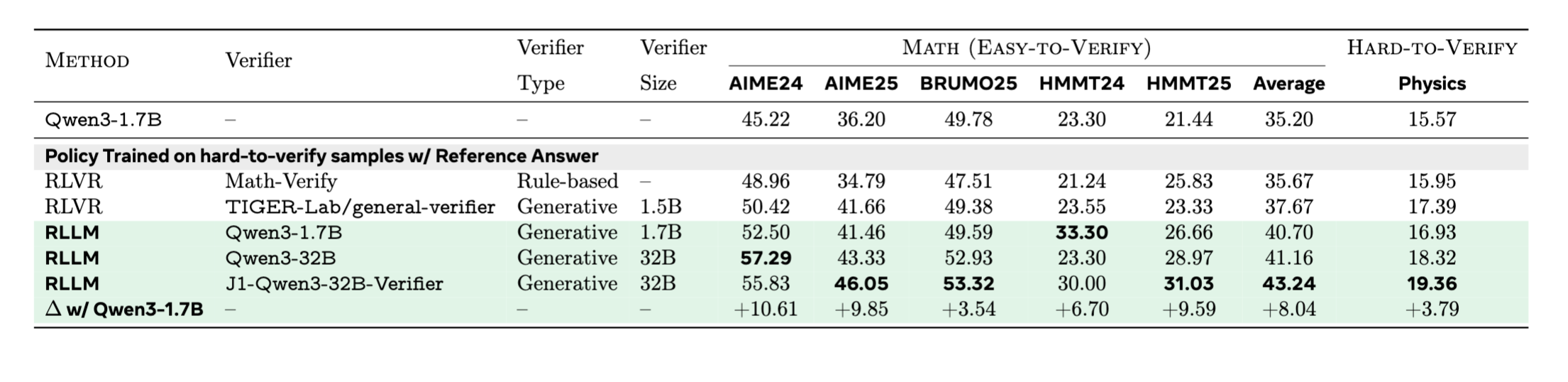 Figure: Reference-based setting. RLLM provides strong results compared to RLVR.
Easy-to-verify vs. hard-to-verify training sets
We also compare RLLM, RLHF, and RLVR across different training datasets – easy-to-verify, hard-to-verify, reference-free, and reference-based. RLLM on hard-to-verify data with a strong LM-as-RM outperforms all models trained on easy-to-verify data.
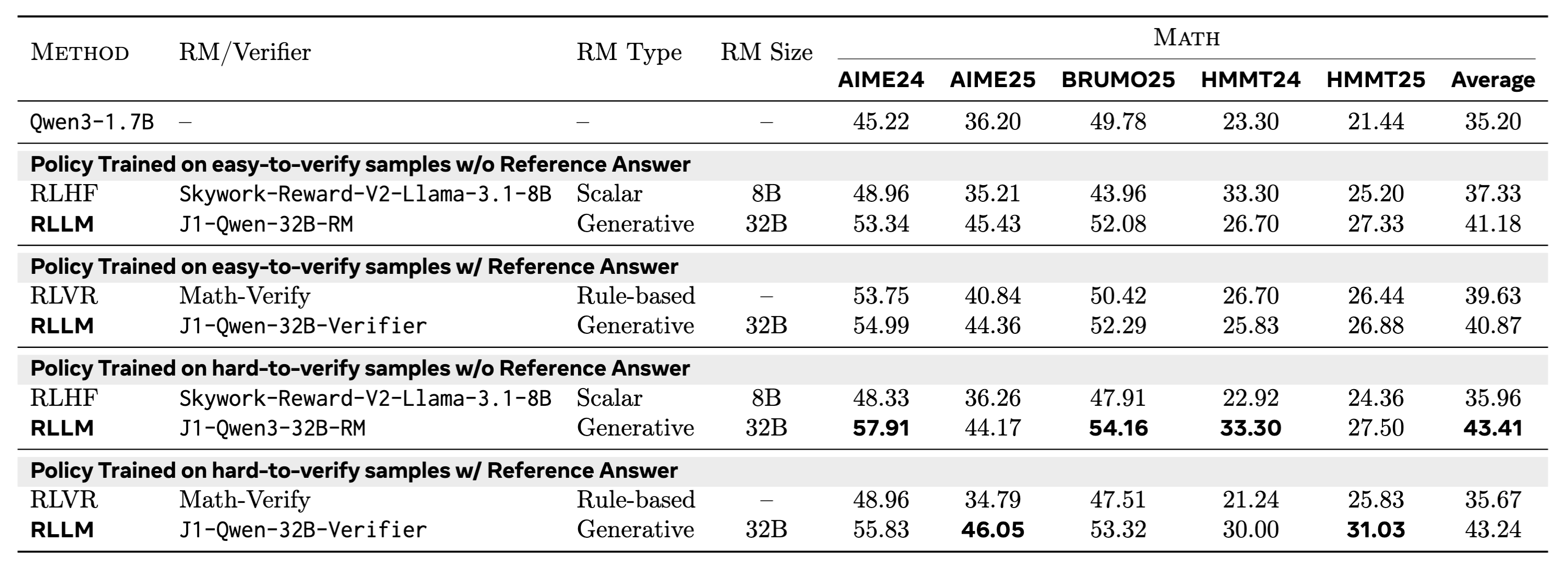 Figure: Easy vs Hard to verify in different settings. RLLM provides strong results compared to models trained on easy-to-verify data.
Non-Verifiable Instruction-following tasks
We also experiment with RLLM on non-verifiable instruction-following tasks. We compare the Win Rate (WR) and Length Controlled Win Rate (LCWR) of RLLM and RLHF when training a Qwen3-1.7B policy (either in thinking or non-thinking mode). For AlpacaEval 2.0, we use GPT-4o as the evaluator and for ArenaHard 2.0, we use GPT-4.1 as the evaluator.
RLLM matches or outperforms RLHF, obtaining best win rates on hard prompts of ArenaHard 2.0.
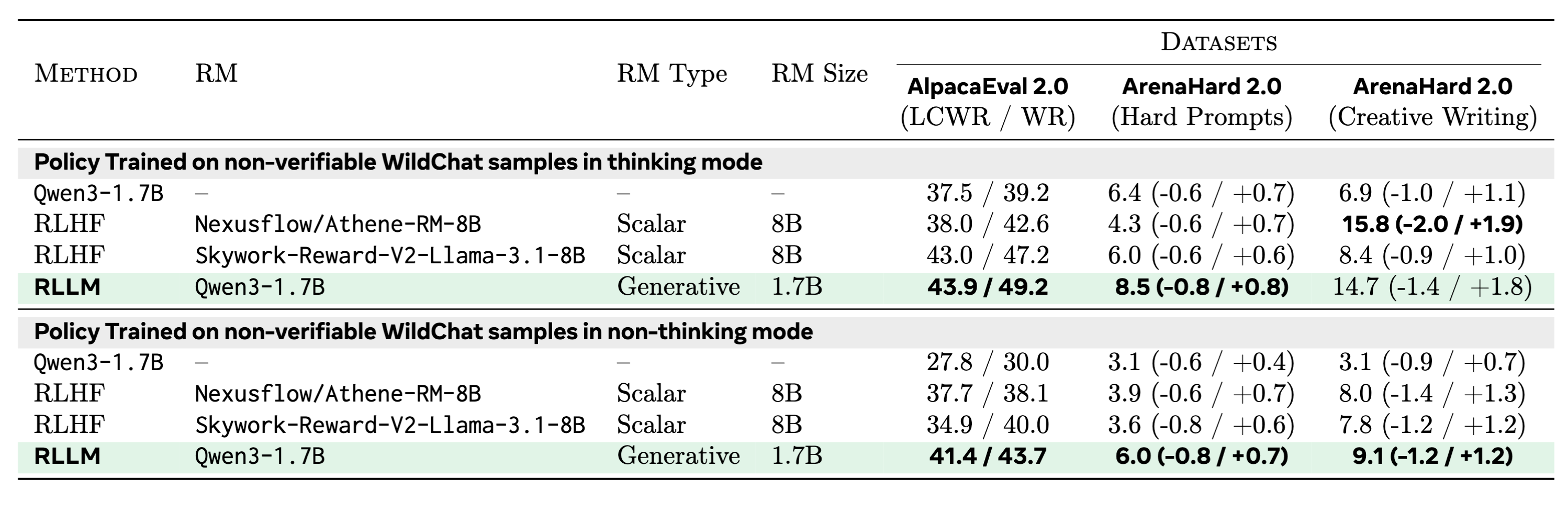 Figure: Non-verifiable task evaluation. RLLM provides strong results compared to competing approaches.
When and why does this work?
We investigate the impact of the generator–verifier gap on RLLM training, specifically examining how the capability gap between the policy LM and the LM-as-RM influences downstream policy improvements.
For our main experiments, we trained a Qwen3-1.7B policy with a J1-Qwen3-32B-RM where the RM was trained on-policy (by sampling responses from the Qwen3-1.7B policy). Now we ask if we train a weaker 1.7B LM-as-RM on its own responses i.e., J1-Qwen-1.7B-RM, can that also lead to downstream improvements?
Our results show that we do not observe further improvements on top of the prompted Qwen3-1.7B-as-RM with J1 training. However, we find that J1 training of a Qwen3-32B model leads to 10\% improvement in judgment accuracy (averaged across 8 seeds) over the corresponding prompted baseline. This underscores the importance of the capability gap between the generator and the verifier for obtaining downstream improvements.
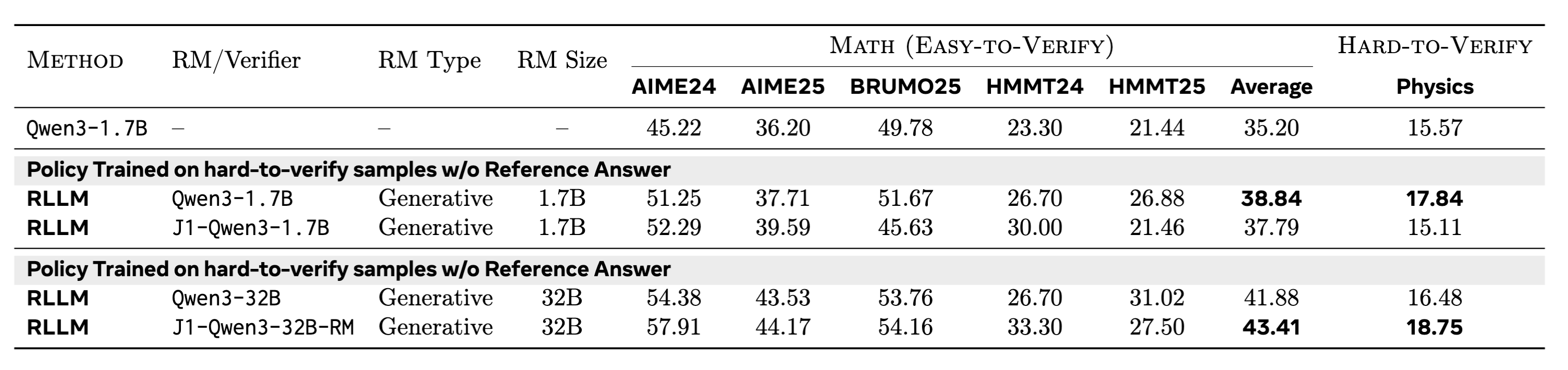 Figure: Analysis of Generator-Verifier Gap. RLLM post-training of a Qwen3-1.7B policy with a J1-Qwen3-1.7B LM-as-RM does not improve performance over the prompted LM-as-RM baseline while post-training with a stronger J1-Qwen3-32B LM-as-RM improves over the corresponding prompted baseline.
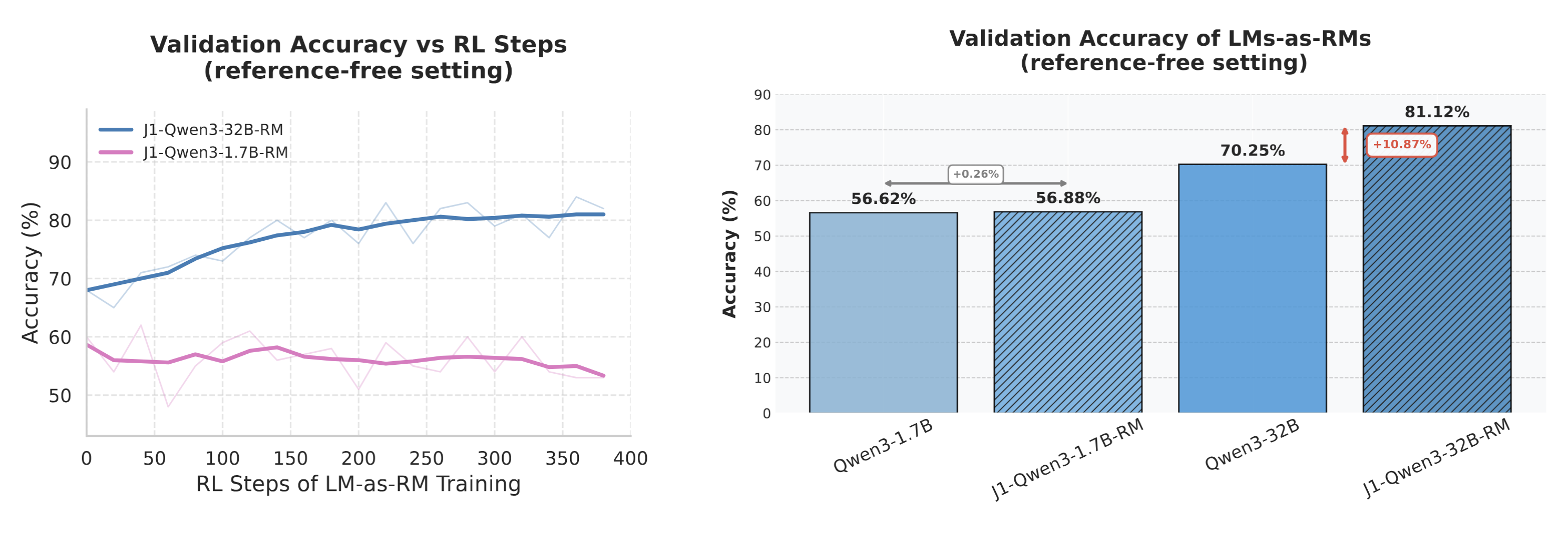 Figure: Analysis of Generator-Verifier Gap. Comparison of different LMs-as-RMs in a reference-free setting on a held-out validation set (of correct/incorrect responses). J1 RM training on top of a weaker Qwen3-1.7B does not lead to further improvements, while the same on top of a stronger Qwen3-32B leads to 10\% absolute improvement. Results are averaged across 8 seeds.
On-policy vs off-policy LM-as-RM training
We compare an on-policy trained LM-as-RM with two off-policy trained RMs. All three RMs are trained on top of the same Qwen3-32B model using the same recipe, differing only in their training data: the off-policy RMs are trained on responses generated either by a weaker Llama model or by a stronger Qwen3-8B model.
Although the results show that training improves judgment accuracy for all these models on their respective in-distribution validation sets, the off-policy trained LMs-as-RMs do not transfer to downstream policy improvements. This shows that RM capability improvements measured on static, offline benchmarks (with different data distributions) may not always be indicative of downstream task improvements because of lack of OOD generalization.
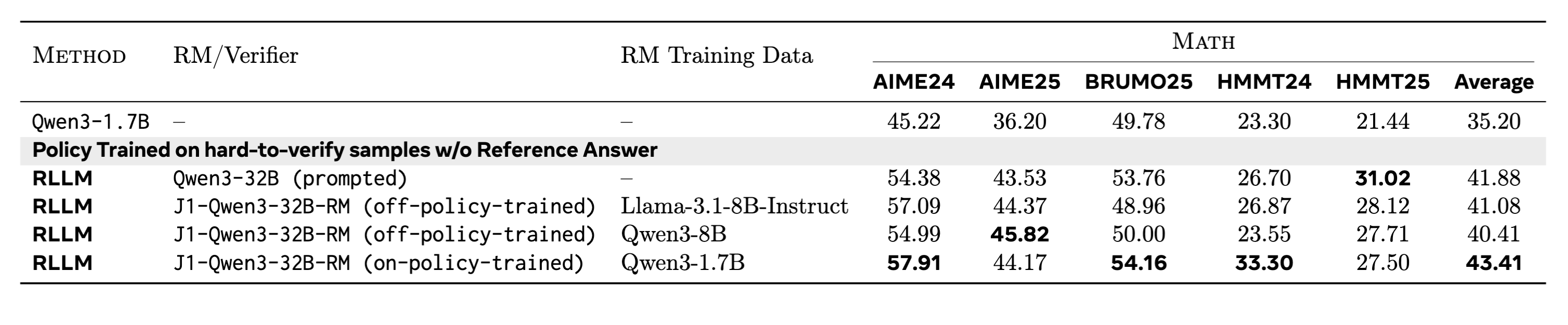 Figure: Comparison of RLLM post-training of Qwen3-1.7B with on-policy versus off-policy J1-trained LMs-as-RMs. On-policy J1-Qwen3-32B-RM is trained on Qwen3-1.7B responses while off-policy models are trained on either weaker Llama responses or stronger Qwen3-8B responses. On-policy trained LM-as-RM outperforms off-policy trained ones.
Scaling up reward modeling compute
For our base non-verifiable tasks experiments we employed a pairwise LM-as-RM, as non-verifiable tasks benefit from relative judgments. Here, we also study the effect of scaling up reward modeling compute by conducting either pointwise, pairwise, or listwise scoring from the LM-as-RM. Since the complexity of pairwise scoring is quadratic in the number of rollouts, we also explore a second pairwise setting where one of the rollouts is chosen at random as a pivot (or reference) rollout to compare against.
We observe that on the hard prompts, win rates improve with more judgments while for the other categories, results mostly saturate at pairwise comparisons. Overall, this highlights the flexibility of an LM-as-RM’s rewarding mechanism, allowing increased compute to be spent on evaluation.
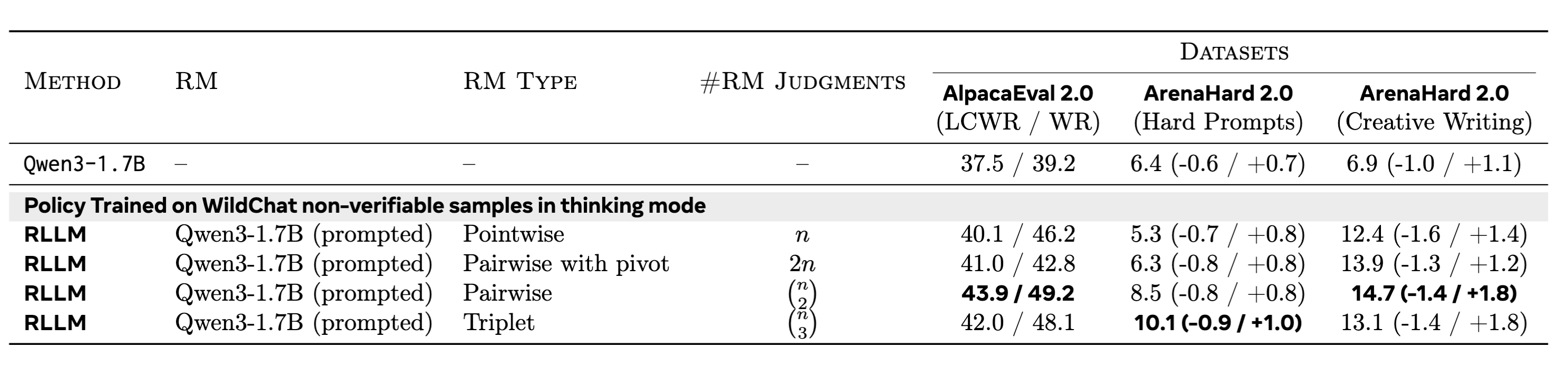 Figure: the effect of scaling up reward modeling compute in RLLM via pointwise, pairwise, pairwise with a pivot rollout, and triplet-based scoring between rollouts methods of computing reward.
Conclusion
We showed that RLLM – RL with (RL-trained) language models as reward models – unifies post-training into one recipe, so the policy model excels across easy-to-verify, hard-to-verify, and non-verifiable tasks. Through extensive experiments, we demonstrated that RLLM outperforms both RLHF (with scalar RMs) and RLVR (with rule-based rewards), showcasing particularly large gains when training on hard-to-verify tasks.
We also studied the importance of on-policy training of LM-as-RM models alongside the impact of the generator-verifier gap and showed that these are important components for successful RLLM training.
Contributors
Chenxi Whitehouse, Ilia Kulikov, Ping Yu, Jason Weston, Xian Li, Swarnadeep Saha.
More details
More details can be found in the full technical report (see section 2).
Citation
To reference the work in this blog post, please use the following BibTex entry:
@article{principia2026,
  title={Reasoning over mathematical objects: on-policy reward modeling and test time aggregation},
  author={Pranjal Aggarwal, Marjan Ghazvininejad, Seungone Kim, Ilia Kulikov, Jack Lanchantin, Xian Li, Tianjian Li, Bo Liu, Graham Neubig, Anaelia Ovalle, Swarnadeep Saha, Sainbayar Sukhbaatar, Sean Welleck, Jason Weston, Chenxi Whitehouse, Adina Williams, Jing Xu, Ping Yu, Weizhe Yuan, Jingyu Zhang, Wenting Zhao},
  journal={arXiv preprint arXiv:2603.18886},
  year={2026}
}